- April 2, 2026

-
-
Loading
Loading
There is always a certain amount of risk involved with any business; will it be profitable? Can the product sell? Can it survive the economy?
For pawnshops, this level of risk goes up tenfold. They, in essence, make their money by giving money: you bring in your old television; they give you $100. You pay them back; you get your TV back.
What happens when the economy tanks and everybody decides they'd rather keep the money than get their old TVs back?
Well, as Disco Pawn in Orlando owner Greg Hastings put it, "You're going to be loaning money out like a drunken sailor!"
In order to make it through the failing economy, pawnshop owners such as Hastings have had to come up with creative ways to survive. They're doing this by changing not only the way they do business, but by working to break the age-old stigma of what a pawnshop is.
Economic effect
On the surface, a bad economy may seem like a pawn owner's paradise.
"People are pawning their grandmothers if they could make a 100 bucks on it," Hastings said. "People are so hurting for cash you'd be surprised the kinds of stuff people try to bring in to pawn."
Though that side of business is booming, the number of people coming back to pick up their property and pay off their loans is at an all-time low.
This means the pawnshops are out the cash that was loaned, and must now take that old TV and try to sell it in their shop. This is where the pawn industry takes the biggest hit — much like every other business finds out in tough economic times — the stuff isn't selling.
"Before, everyone picked everything up — they'd come in and put a loan on it and pick it up," said Ryan Stumpf, the owner of Instant Replay pawn in Orlando. "We used to run like a 64 to 65 percent reclaim average so the majority of the stuff would get picked up.
Nowadays your running like a 35 to 45 percent average … it puts us at a disadvantage too — now we have to sell it."
As Hastings put it, pawnshops like his end up merchandise rich and cash poor.
"The general public thinks you're making so much money, and yeah it's a high rate of interest, but it's a tremendously high rate of risk," he said.
Breaking the bad reputation
Stumpf said the majority of Americans have never been inside a pawnshop and so they can only relate their experiences to what they've seen in the movies.
"In the movie, you see a really dingy little joint," he said, "with bars and armed people and big fat slobby guys."
"They've always had a bad reputation. Before I moved to Florida, my image of a pawnshop is some big, old, fat, crusty dude with a stinky cigar hanging out of his mouth, and a couple of guys in the back playing poker … generally speaking, those days are gone," Hastings said with a chuckle, as Taylor Swift's innocent voice played over the loud speakers in his shop.
There is a certain stigma that comes with the idea of a pawnshop being dirty and crawling with criminals, which Hastings and Stumpf willingly poke fun at, but each say are grossly misconstrued.
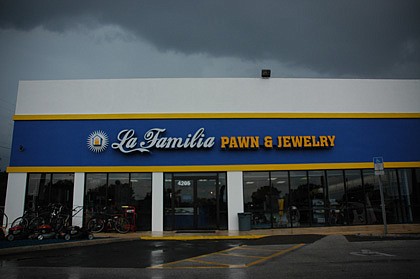
Hastings compares the look of most pawnshops today to what someone would expect to find in a Winn-Dixie. By going for more of a retail setting, pawnshops can draw in "mainstream" business, such as the La Familia Pawn Shops stores that are going into old Blockbuster locations.
But that doesn't mean all pawnshops have cleaned up their acts, Stumpf said. "There's always a few bad apples, but I think a lot of people don't understand what kind of regulations pawnshops go through these days."
In order to sell to a pawnshop, the shop must get the serial number for the item being pawned and the fingerprint of the person coming in to pawn it. This, Stumpf said, often deters criminals from trying to sell stolen items. "Usually criminals are pretty smart cause they know we're so heavily regulated," he said.
Getting a pawn license to begin with, he said, is equivalent to signing your civil rights away.
"Cops can come in my store at any time; they can go through my inventory; they don't need search warrants; they can just come in and say 'Look, I'm gonna go through your store and there's nothing you can do about it.' If you don't have proper documentation and proper paperwork, they fine you, and they have the ability to take you to jail very easily," Stumpf said.
Hastings said his own gut instinct is the most vital business tool he uses as a pawn owner to keep his business afloat.
"If a guy comes in here with beady eyes and he's shaking and his nose is running, and he can't even talk straight and he's gritting his teeth and he's got a $3,000 Fender guitar and he wants to sell it to you for $100, you know damn well the thing's gotta be stolen," Hastings said. "You know, you gotta use your judgment, just like a bartender. If you know a guy's drunk, you don't sell him another vodka and tonic, right?"