- April 2, 2026

-
-
Loading
Loading
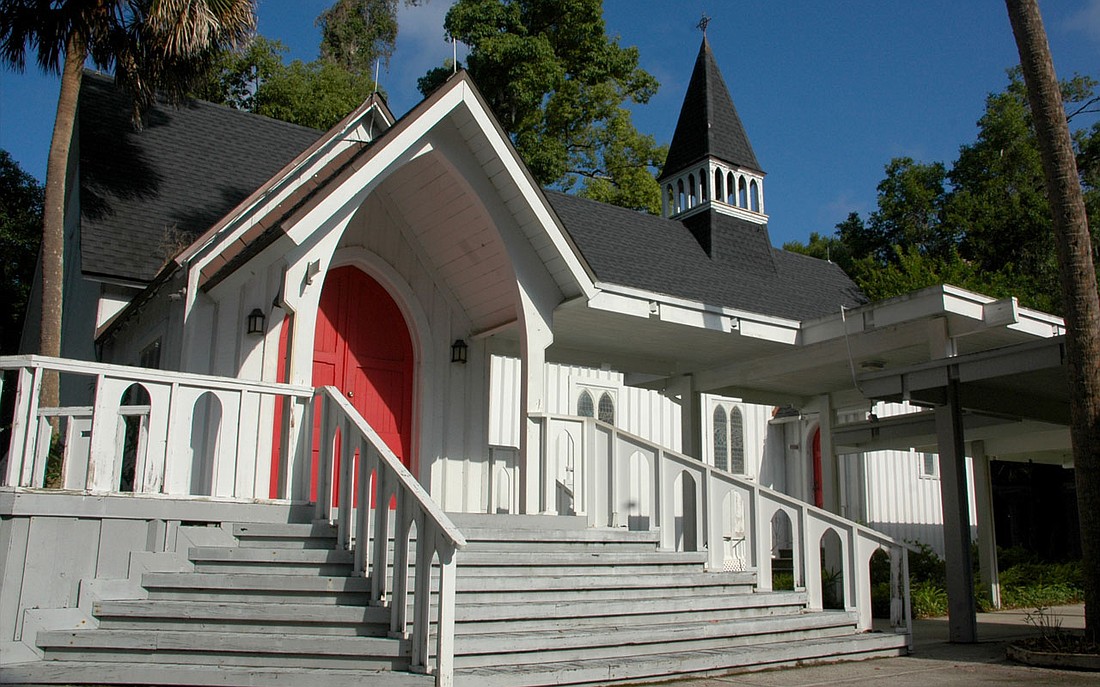
Maitland’s Episcopal Church of the Good Shepherd on Lake Avenue has been a silent observer of Florida’s history for more than 120 years. Like an elderly Southern lady, the church does not shy from showing its age, as if confident in the grace and bearing that age may bestow.
The white and gray wooden sidings and pyramidal roof appear like a scene from a Norman Rockwell photograph and are in contrast to the bright red double doors that beckon in visitors, just as they must have for the first settlers and native Seminole tribes in their day.
Now the Church of the Good Shepherd has solidified its place in the history books. Last month, it was added to the National Register of Historic Places.
Gothic style
Beside its age and history, the church received recognition for its architectural and artistic significance, specifically its crafted stained-glass windows. The church is of the “Carpenter Gothic” style popular in America and Europe at the time, and is one of only eight surviving churches in Florida built in that method.
Robert Jones, historical preservationist with the Division of Historical Resources in Tallahassee, said Carpenter Gothic was a return to the Gothic style of medieval times, which was itself an evolution of Romanesque architecture. The Gothic style was most prominently displayed in the construction of cathedrals like Notre Dame, with pointed arches and flying buttresses and is “an example of early American architecture that attempted to create high art at a low price,” Jones said.
The stained-glass windows are executed in the “Aesthetic Style,” a reaction to the Industrial Revolution’s emphasis on standardization through a focus on simple, non-didactic beauty, usually through representing scenes of nature. The Church of the Good Shepherd’s finest example of this is two lancet windows on the church’s south side that depict kneeling angels with wings curving high above them.
The church’s history includes a veritable who’s who of state and national figures, some who were in the infancy of their famous careers when construction began in 1882. In research Jones collected for the church, he found that it was built by James McGuire, a later favorite of Henry Flagler, and would go on to build several prominent structures for him in St. Augustine and Nassau, including the Flagler family Memorial Presbyterian Church in St. Augustine.
The architect was Charles Haight, whose credits include several surviving buildings at Yale University and the New York Cancer Hospital. The glasswork is attributed to Charles Booth who worked both in New England and London.
Rev. Whipple
Inside the church, a large gold plaque adorns the entrance to the chapel. The inscription shows it to be in honor of the Rev. Henry Whipple, first Episcopal bishop of Minnesota, and founder of the Church of the Good Shepherd.
Whipple is perhaps best remembered for his ministrations among the Dakota and Sioux tribes in an age when Native Americans were met with great hostility. Following the Sioux Uprising in 1862, 303 members of the tribe were scheduled to be hanged. Whipple’s pleas for clemency to President Lincoln received pardons for 265 of those numbers.
In 1879, Whipple moved to Maitland, the home of his son, in hopes that the warmer climate would benefit his health. While touring the area, he noticed the dire situations of some of the area’s poorer inhabitants, especially the remnants of the Seminole tribe whose recent defeat in the Seminole War had left them destitute.
Whipple’s home once stood across the street from the site of his future church and near the railroad tracks, which were only beginning to bring settlers and citrus growers to the state — at the time, Maitland’s population was around 130 people. The early deaths of Whipple’s son and daughter prompted him to purchase the property across the street and to build a church as a memorial.
In a collection of his remembrances of the time, “Bishop Whipple, Lights and Shadows”, Whipple writes “…the parish is made up of people from widely separated homes, and different religious antecedents, but all unite in the service…. To many children of the Church of England, who have found a home here, this House of God has been the Gate of Heaven.”
Of the notable stained-glass windows, one in particular is dedicated to Whipple and is inlaid with his symbol, that of a peace pipe and a broken tomahawk under a large gold cross. The bishop’s chair and altar at the head of the church are the same as they were in Whipple’s day.
“He is quite a man, Bishop Whipple, and I hope that we continue his ministry,” said the Rev. Sarah Bronos, the current leader of the Church of the Good Shepherd. Bronos described that ministry as one of openness and service to the Maitland community, such as through the church’s food pantry and ministrations to hospitals and nursing homes.
Growing and changing
The Church of the Good Shepherd has grown substantially since its inception. The sprawling complex includes a more modern sanctuary built in 1967, and services are divided among the older and newer buildings. Of the age of the structure, Bronos smiled and remarked how the beliefs that founded the church were much older.
“We are a continuation of history,” she said, “a continuation of what came before.” She said that the church’s recognition as a historic landmark was an opportunity to see more people and connect them to the history of Maitland and the history of Christianity.
“I hope that we continue that heritage, which is more important than the bricks and mortar,” Bronos said.
Of course, upkeep of a late 19th century wooden church is a daunting task, said Richard Colvin, curator of Art and History Museums, Maitland, and without significant community support, these buildings are often demolished. Colvin said the Church of the Good Shepherd is a connection to an architectural style that cannot be replaced, as well as showing how the community grew and changed.
“It’s a lasting example of what was,” Colvin said. “A picture is a ghost.”