- April 3, 2026

-
-
Loading
Loading
The storm is coming in a hurry as Joe Cordeiro walks briskly along the edge of a grassy field and toward his tiny trailer, a few feet away from a 40-foot tall lightning rod.
The dark gray clouds spiral overhead as the first sounds of thunder rumble in the distance.
“It happens this way every year,” friend Mike Welch said, his eyes just under a white cap filled with buttons and the code W1MNW, staring down at his smartphone’s screen that glows electric red from the torrent about to arrive. “It’s coming right on top of us.”
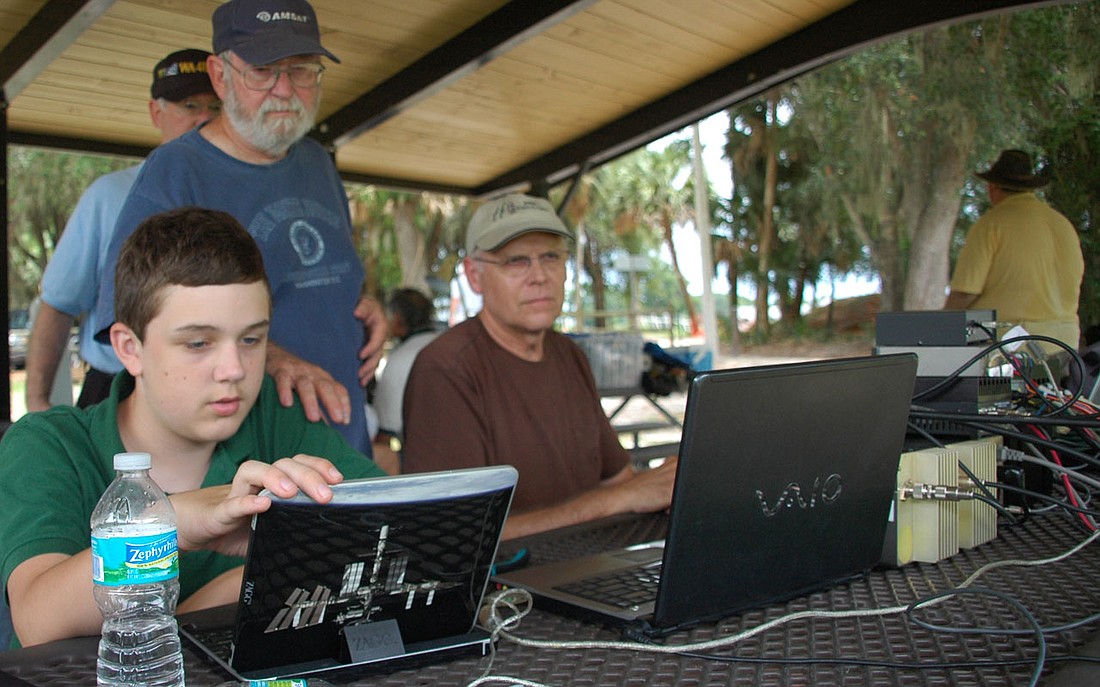
Across the field under another pavilion, Dave Jordan types a few keystrokes on a laptop and a symphony of machinery starts whirring in front of him, pointing a 10-foot tall satellite antenna to chase after a 17,000 mph ball of metal shooting across the dome of the Earth.
When it crosses into his antenna’s field of view, he has just nine minutes to ricochet a signal off of it and say hello to as many people as he can on the other side. With any luck, one of them will be in a space station.
The satellite antenna spins into position, then suddenly a crackle and a voice. At 2:22 p.m., Indiana says hello with a rapid string of nearly unintelligible alphanumeric jargon and then disappears. In an instant, another voice crackles to life. Someone from Georgia is doing just fine — and with a quick hello, where are you, goodbye, it’s over.
In just more than a minute, Jordan finds four people from as far as 4,000 miles away. On a digital map on his computer screen, he watches the speeding hunk of metal bouncing signals from space, just before it goes silent somewhere north of Canada and hurtles into the blackness beyond the solar horizon.
“We can go home now,” Jordan snaps off dryly, knowing he could be here another 20 hours. Despite his quick success on the airwaves, it is going to be a long night.
Just a few minutes later, the storm closes in, dimming the sky to twilight four hours too early. It is coming from five directions at once, as two dozen men scramble to unplug electrical cables as thick as garden snakes before a bolt from the sky can blow their equipment to pieces.
“If you get a lightning hit, you look like the cat in the cartoon, only you don’t get up,” Cordeiro said.
In a second, the storm fronts all hit at once, as the men stand in a blowing mist under an empty pavilion and watch as a powerful blast of wind and rain threaten to sweep them away. But this is what they are here for, however accidental. This is their time to be heroes.
They’re the storm team you never hear about until you need them, and then with the click of a microphone, they’re there. Today amateur radio groups from across Central Florida and nationwide are saving the world, one contact at a time.
For the men wielding microphones and telegraphs in the middle of this park, it’s all fun and games, today it’s all fun and games, but it’s also serious business. They’re the Lake Monroe Amateur Radio Society, and they live for the moment that plunges the world into darkness.
It may be a coincidence that Cordeiro, Welch and dozens of others picked June 25 to roll out onto the tree-ringed field at the west end of Winter Springs’ Central Winds Park, but it is not without a purpose.
“This is why we do it,” radio operator Norm Lauterette said.
Every year since before the internet revolutionized communication, he’s trudged out into a field, strung antennas across it and spent most of the weekend calling the world. At the end of June, every year, for 24 hours straight, radio operators across America fire up megawatt generators and blast radio waves around the globe to find somebody on the other end.
For the amateur radio world, this is judgment day. The power is gone — they run only on whatever power an engine hooked to a generator can muster. They use every kind of radio they can get their hands on, so long as it broadcasts from the middle of this field.
When the power is gone, emergency crews turn to the hams for help directing supplies, calling in emergencies and keeping the lines of communication open. In 2004, when three hurricanes hammered Central Florida in a two-month span, that’s exactly what they did.
But today there is no emergency. It’s all for points, to see who’s the greatest communicator.
The storm passes and the men trudge through what rain has turned into a swamp and plug back in. The clock starts ticking at 2 p.m. By 4 p.m., they are way behind. The LMARS team works as a group, lighting up an array of antennae ranging from a few feet long to the 40-foot tower shooting skyward next to Cordeiro’s 8-foot long trailer.
And then they are off to the radio relay races. They have catching up to do.
“We just got right back to work,” Welch said. “We’re used to it by now.”
And so on radio stations, they click, talk and type their way through two centuries of communication technology, trying to get as many hellos as they can. In the middle, Winter Springs Mayor Charles Lacey, call sign N5NEB, drops in to say hello in person.
As usual, the gang of raccoons that began plaguing the group’s makeshift campground with late night attacks three years ago eventually makes an appearance, but Welch said the LMARS group is more prepared this time. They stop the first one that makes a reconnaissance attempt, and that is the end of it.
“Oh, they know about us now,” Welch said. “We just shooed him away and went back to work.”
By the time the morning air evaporates from a choking fog and the LMARS team rolls out, they have a record under their belts: 567 contacts in Morse code, more than double last year, coupled with more than 1,300 contacts worldwide.
Considering they were missing a radio station from last year, Lauterette said he’s happy to be among the best, dark and stormy night notwithstanding.
“We had less stations going, but we did more with it,” he said. “This year was not bad.”