- April 2, 2026

-
-
Loading
Loading
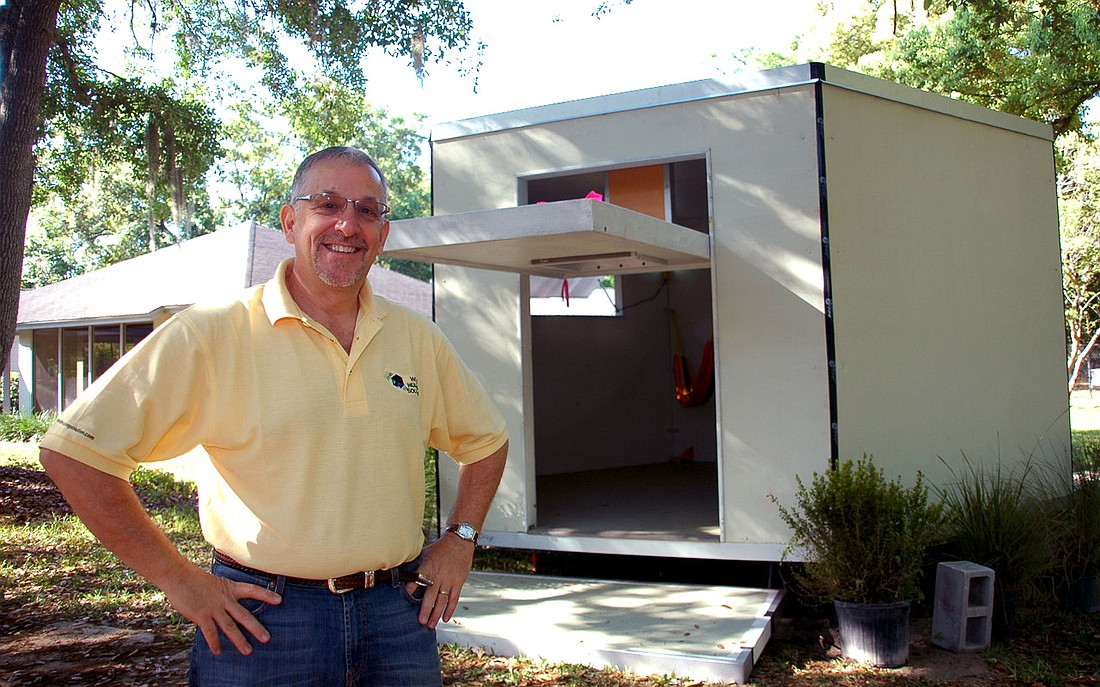
Ron Ben-Zeev wants to save the world. He grins often as he talks about the strange white hexagon-shaped building rising on short stilts behind him.
It’s the size of a small bedroom, looks like it could be at home on a construction site or the moon, and he says it can keep a dozen people safe from a Category 5 hurricane. And it’s simple enough to be built in a few hours.
“It really isn’t rocket science,” he says with a wink. “But it is rocket science.”
He winks a lot, as his words meld into a sincere sales pitch about the space-age-but-remarkably-plain shelter he hopes his company, World Housing Solution, will soon be shipping around the world to disaster zones, where simple comforts like dry shelter have literally washed away.
Rescue mission
Friday morning, as he paced a broad circle around one of his tiny portable homes under construction behind the Church of the Good Shepherd in Maitland, his mind raced off into the distance.
More than a year ago, Haiti, the poorest country in the western hemisphere, became the victim of one of the worst earthquakes to ever hit the country. Just weeks ago, Japan suffered possibly an even worse fate as it was hit by an earthquake, tsunami and nuclear disaster in the same day.
In the aftermath in Haiti, what were supposed to be short-term living solutions have turned into a disturbingly permanent way of life.
“Six hundred and fifty-thousand families were made homeless in Haiti — not 650,000 people, 650,000 families,” Ben-Zeev said. “And they still are. They still haven’t rebuilt.”
The tents that immediately cropped up after the earthquake soon turned into functioning tent cities spanning dozens of acres. There was no water, no kitchens, no sewers.
And in those makeshift cities, crime soon started running rampant. “The tent cities aren’t safe, especially for women,” Ben-Zeev said, recalling stories of rapes.
A solution
So he and his Central Florida company, World Housing Solution, designed a building that can stop a crime before it starts. He points to a wall that two teen girls are holding easily in their hands. “That can stop a .38 caliber bullet.”
WHS had to tackle two engineering challenges at once to create a home to protect a dozen people at a time from the elements and from each other.
It had to be light enough to move easily. WHS’s building takes up 180 square feet — the walls, ceiling and floor comprise only 10 total pieces, all of them small enough to fit on a 10-foot trailer. They’re versatile enough to act as an entire home, a bedroom, a kitchen and bathroom, anything, he said. And they can be self-powered and recycled as well.
And they had to be strong enough to stop another disaster. Ben-Zeev said they can stop a 150 mph hurricane and a 7.7 magnitude earthquake — higher than the one that hit Haiti, but not the massive 8.9 temblor that devastated the northeast coast of Japan. He hasn’t had a chance to field test those claims yet, though they’re backed up by engineering. But he has a few tricks he likes to try out.
Standing strong
As the sun headed for the horizon later on Friday evening, in front of a handful of video cameras, Ben-Zeev tried to set a piece of his building on fire. He aimed a torch a few inches from a piece of wall, and lit it full blast. A few black scorch marks were all that 2,200 degrees of white concentrated flame could do to injure the phenolic resin skin.
Then he tried to destroy it with a sledgehammer, which he’d easily smashed through a concrete block a moment before. Against the foam and resin wall, the sledgehammer didn’t leave a dent.
“The only real danger is when the sledgehammer bounces back,” Ben-Zeev said.
The strength comes from a combination of steel plates rimming the outer edges of some pieces of the floor and ceiling, plus a layered sandwich of foam and resin on the outer surfaces. The result is floors and ceilings that can be lifted by two men, walls that can be lifted by one, and the adaptability to be built on a mountainside in a few hours.
Easy to move, build
Earlier that day, he watched a crew of a dozen men digging holes and leveling out adjustable stilts that hold the structure off the ground. Construction crews can be trained on site, he said.
“Half of these guys have never built one of these before,” he said, staring out at a motley crew ranging in age from an athletic-looking college-age man in a cut-off T-shirt to a nearly 70-year-old man in khaki pants.
All but four are volunteers, though there’s a handful of engineers among them.
The man dirtying his khakis in a 2-foot-deep hole in the sand is Kent Davis, a Ph.D. civil engineer who can compute structural load forces in his head while he shouts instructions across a field.
“Who’s filling in these holes, boys?” he yells in between sips of water. He’s been out here all day Friday, ensuring the wind-proof design lines up properly, from the stilts buried in the sand to the flat ceiling capping it off.
“It’s all intuitive,” Davis says of the construction. “They all learn pretty quickly.”
Sending help
Four hours after the first shovel went into the ground, visitors were lying down in a hammock inside. An experienced crew can do it in less than three hours, Ben-Zeev said.
“This would make a great hunting camp,” Good Shepherd senior warden Wayne Waters said, staring at the finished product, with its wide-open door that rises like a castle’s portcullis and bolts down securely at night.
Ben-Zeev hopes to have these on the ground in Japan and Haiti in a matter of months. But that takes clearing government processes to get them across the sea and around the globe. He’s hoping that getting approval is more of a “when” than an “if.”
“They’re very interested, but we have to jump through hoops,” Ben-Zeev said, hoping to clear the final hurdle soon to start the construction phase. “Hopefully we’ll be over there soon building these.”
Visit www.WorldHousingSolution.com for more details.