- April 3, 2026

-
-
Loading
Loading
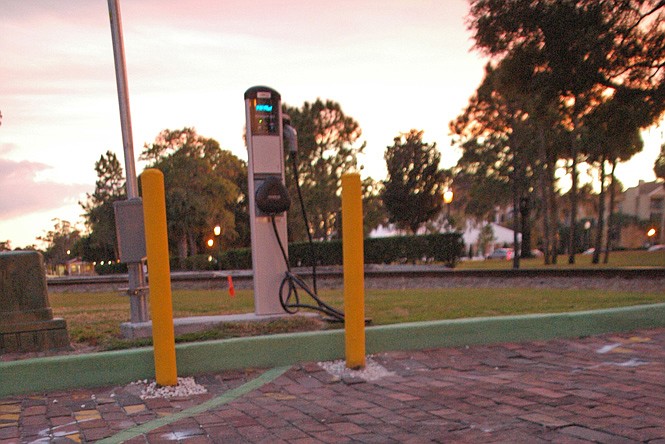
Winter Park’s roads may have gotten a little greener, thanks to a quiet move by the City Commission on Feb. 13 that will make electric car charging stations free to use indefinitely in the city.
“We’re taking a leadership position on this,” Commissioner Steven Leary said about the city’s newest green program, which joins sustainable living programs and health programs the city already is pushing. “We’re trying to do things healthier in a lot of ways.”
On Jan. 10 the city unveiled six new charging stations throughout the city that will add to the about 300 electric charging stations already spread out throughout Central Florida. The difference with Winter Park’s program, at least initially, is that it will continue to be free to use.
“It’s an important experiment,” Mayor Ken Bradley said about the program. “I think it encourages people to at least consider buying an electric car.”
The rationale for the free program, electric utility director Jerry Warren said, is that, aside from free charges enticing electric car buyers, the cost to set up a pay system for the charging stations would cost more than simply giving away free electricity. The city would only spend a few dollars per month at the current rate, he said.
Though they were officially unveiled in January, the stations were already in use since late November, topping off batteries at the Public Safety Building, Garfield Avenue at the north of Central Park, the public parking lot at the Amtrak Station, the City Hall parking lot, Hannibal Square parking lot and the Azalea Lane Tennis Center.
With totals from December and January already in the books, city staff discovered that the stations had only charged cars 31 times so far, with an average use of 2.9 kilowatt hours. That’s about half the average charge consumption reported by ChargePoint America, which locates where charging is available and tracks electric car use.
The 10 charges that occurred in December averaged 3.5 kilowatt hours per charge. In January the number more than doubled to 21 charges, but the kilowatt hours per charge dropped to 2.7 per charge.
At that rate, the city would need about 50 percent more users beyond the projected 50 charges per month before it would break even on the program.
The city may reconsider charging drivers to top off their batteries in the future, at a rate of 12 cents per kilowatt hour, according to Warren’s estimate. That would cost the average user of the system only 35 cents per charge.
Until more drivers are enticed into buying electric cars, Bradley said that he thinks it’s worth giving away.
“If everybody was driving an electric car, I’m sure we wouldn’t be giving it away for free any more,” Bradley said. “But it’s kind of like a new business in town; maybe they give a few cookies away at the start.”