- April 3, 2026

-
-
Loading
Loading
It can show itself in the clumsiness of feet, tripping over barely there sidewalk cracks and carpet corners; the growing laziness of the tongue, slurring everyday speech making regular enunciation labored; the suddenly increasing inability to fully grasp a loved one’s hand.
The symptoms that lead to a Lou Gehrig’s disease diagnosis can differ, but the accompanying weight of its sentence is uniformly grave.
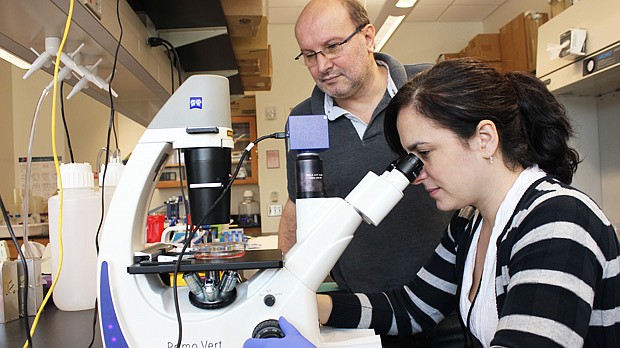
“Right now, it’s a death penalty,” UCF College of Medicine professor Alvaro Estevez said.
To learn more about Alvaro Estevez and his ongoing research at the UCF College of Medicine, visit tinyurl.com/AlvaroEstevez
Death is a universal truth, but those diagnosed with Lou Gehrig’s – also known as ALS –at an average age of 55, face an average life expectancy of three to five years post diagnosis, according to the national ALS Association.
Following the news of a man’s ALS diagnosis, Estevez remembers sitting in the room with the patient and his doctor, the man pleading for any help and hope of making it a few more years to see his young children graduate from high school.
“That was the only thing that he wanted,” Estevez said. “And a couple more years, that would give him that. And well, it’s not enough, nothing is enough, but if we can do that, it would be great.”
For more than 20 years Estevez has been leading research into the functions of proteins and how clues of how they oxidize in the body may hold the secrets to treatments for many pathological diseases from ALS to cancer and heart disease.
He, with the help of scientists and researchers in universities across the nation, have found what they’ve named an “executioner” protein, which through a certain form of oxidative stress – called tyrosine nitration – turns a cell into an “executioner” shutting down and killing itself.
“It’s a protein that’s associated with survival, so when the cell is in trouble they produce huge amounts of this protein to survive… and then the modification of one residue in these proteins actually shifts these proteins from this pro-survival action to a dead pathway,” he said.
By knowing this, Estevez said he is hopeful that his team can develop a drug to halt tyrosine nitration – an oxidative process linked to inflammation – from occurring, protecting healthy cells from being killed. With inflammation being a predominant factor in the cause of the process, and a common occurrence in the onset of many pathologies, it’s possible, he said, for the research to benefit a long list of different conditions from strokes to spinal cord injuries.
“In the worst condition, we have a diagnostic tool so we can find the protein and we know that there is a problem. In the best condition we have a target, so if we can develop a specific pharmacological tool to attack these protein and prohibit these negative actions, then we may have a treatment for disease,” Estevez said.
Dr. Neil Cashman, a specialist and scientist in ALS for 25 years, said Estevez’s research is in an avenue he’s never seen explored before, and of high significance for all those who’ve been searching for treatments and cures of neurodegenerative diseases for decades.
“I found Alvaro’s findings to be kind of a breathe of fresh air,” Cashman, the academic director of the Vancouver Coastal Hospital ALS Centre, said. “It’s a specific target to go after rather than thousands of non-specific targets. It kind of focuses the field on something that can be accomplished.”
The process of taking Estevez’s team’s finding and turning them into an FDA-approved drug could, at the very least and if everything from now until then fell into place perfectly, take a minimum of 10 years. But, Cashman and Estevez agree, signifies progress well overdue.
“Our goal is to develop a cure,” Estevez said. “And we are going to do whatever it takes to get there.”