- April 3, 2026

-
-
Loading
Loading
The package came unexpectedly in the mail, eight months after she had requested records from an overseas shipping company.
“The only message that came with it was ‘you were meant to have this,’” Karen Jacobs said. “There was no name, no nothing.”
It was an odd shape, at least 3 feet on a side. Inside, a relic from the past waited.
Jacobs, an Oviedo resident, has spent much of her life piecing together the puzzle of her family history. Saturday she taught students how they can do the same at the University of Central Florida’s Public History Center in Sanford.
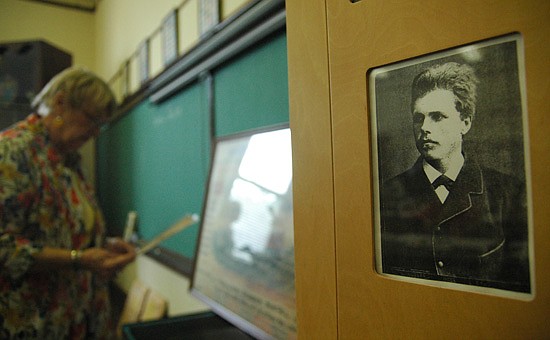
As she taught, an old, wooden-framed advertisement for Bullard, King & Co.’s “Natal Line of Steamers” stood behind her on a table. It’s one of her most prized possessions; it’s the one that came mysteriously in the mail.
Her grandfather worked on the company’s steamboats as a stoker, someone who tends a ship’s furnace. Now he’s another chapter in the family history she’s been uncovering and writing about for more than 20 years.
“It all started with a suitcase full of pictures my grandmother gave me,” the former coordinator of the Museum of Seminole County History said.
She wanted to know who the people in the pictures were, and out of 105 photos, she was able to identify every person except for three. As her hands flit back and forth, telling her own tale, a photograph of an old Scandinavian man stares back at her. Thanks to Jacobs, Magnus Backlund’s portrait has a name again. But the thrill of the chase keeps her searching for those three names she couldn’t find.
History didn’t interest Jacobs much back in high school, but the detective-type work involved with discovering her family history has become one of her passions.
“I like CSI work,” Jacobs said with a chuckle. “I like a good puzzle, a mystery.”
On a side table of the classroom sits an assortment of large custom-made three ring binders made of wood and leather. The pages tell tales of her family’s journey to America.
The process of gathering, sorting through, and documenting the information on those pages can be complicated. That’s why Jacob’s experience was useful to the community members who came out to her class.
All but two of the 20 or so students were women, averaging in their mid-50s. Sarah Newton, an elementary teacher at Pine Castle Christian, has been involved with the pastime for 20 years.
“I’m like the family historian,” she said.
She loves passing new info on to her niece. A big moment for her was finding old newspaper articles about her cousin’s home that burned down. Her mom had stashed them in a desk drawer where nobody would have ever seen them, she said.
Christine Dalton, the historic preservation officer for the city of Sanford, was there for a slightly different reason. She’s doing research on Elton Moughton, a Sanford architect perhaps most famous for designing the Mayfair Hotel building located in the downtown historic district. She wants to learn new techniques of finding information on him.
“I’m trying to identify which buildings are actually his,” she said. “We know he built some of the churches, the old city hall that was torn down, and schools in Sanford.”
She plans to write a book about her findings, whatever they may be.
The historic buildings of Sanford are worth keeping, Jacobs said, so people know where they came from. UCF leased the Public History Center last year so it could stay open. The class Jacobs taught is part of an ongoing effort to keep it in use.
“It’s just like this building right here, the county cut costs for it,” she said. “I think when you start tearing down buildings, you sort of tear down the weaving of all of the historical roots that go with it.”
Inside the whitewashed, weathered wooden doors of the building’s west wing, she helped a few students weave their roots back together again.