- April 2, 2026

-
-
Loading
Loading
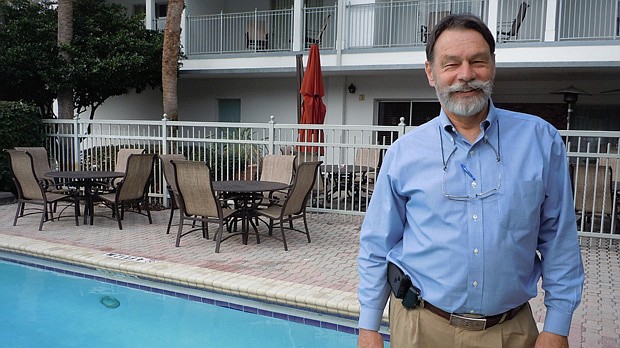
My first night in Winter Park was spent at The Mount Vernon Inn. It was an appropriate beginning to my time here.
Residing in Fort Lauderdale at the time, I was living in a 1930s Spanish-style home that had changed me, awoken something. Perhaps it’s that “old soul” thing, but I came to realize how much I enjoy living in and being a part of something that has stories to tell, a history. We had a guesthouse with the most delightful mosaic around its largest window, the marbles of some kid who used to live there – unearthed during landscape work – made part of its colorful design. I’d tell its story and get a literal chill up my back.
So the Mount Vernon Inn was an appropriate first stop for my Winter Park experience. Little did I know, its owner, Rick Frazee, would also be one of my first neighbors here. He is, I’ve found, not simply a great promoter of that property, but as we talked in the hotel’s Red Fox Lounge on Monday, quite an enthusiastic promoter of Winter Park as well.
Rick, it seems, could have just as easily ended up a New England dairy farmer. His father, an aerospace employee, was convinced the industry was headed for recession. With that in mind, he began looking at and even making offers on dairies in New England. With none accepted, he turned his attentions to hotels in Florida, and in 1962 moved his family to Winter Park, new owners of the Mount Vernon Inn.
Part of the area’s “million dollar mile” – a nickname for much of U.S. Highway 17-92 during the ‘60s because each mile of property was believed to be worth roughly $1 million dollars – the Mount Vernon Inn was built in 1949. “They didn’t go with the George Washington thing until dad bought it, to my knowledge. But it was the Mount Vernon. There were a bunch of Mount Vernons built – motor inns – built all over the country. My guess is it had something to do with after World War II, retiring service people were looking for a career, something they could do, and an awful lot of them were from New England, and Florida was beckoning. And George, if you go around New England, slept all over, you’ll see little signs in front of houses: George Washington slept here. And my guess is people thought that tourists might relate to that.”
Starting with mowing the lawn that first summer, Rick has worked on or around the property for more than 50 years. “Some of the early post cards, out by the pool, have all the kids in it,” he said of himself, his brother and sisters. “You can’t really tell who we were, but it looked better to have people in the pictures.”
Those early days are still among his favorite memories, especially that of when the 1950s television star, Richard Boone, would stay there. “He played Paladin and he used to come and stay here. He was kind of a – I guess growing up in the ‘50s – he was always kind of an idol. He was always the good guy who wore black. He had a black hat, black shirt, black pants. But he was always the good guy. And almost every time he stayed here, somewhere in town in a bar he got in a fight. He was a problem, but he was a wonderful person if he wasn’t drinking. It was great to have him stay with us.”
His official employment at the Mount Vernon didn’t start until 1971, working for his father. His current assistant manager is someone he hired as a bartender back then, and married her husband at the hotel. They moved away to Texas then back to Central Florida where she worked for other hoteliers, then retired. He persuaded her to come out of retirement. A cook in the kitchen has also been with the hotel for more than 30 years.
He admits, “I don’t think I realized how special Winter Park was until I got to travel some. You go out around the country and around the world and you begin to recognize what it means to live in a community where you belong. You can have some ties, roots and it’s not like living out in Tuskawilla, where everything’s just a big, amorphous subdivision and yeah, you might know your neighbor, but there’s no real fabric out there that holds everything together like there is in Winter Park.”
I ask about what that fabric is and his look gets thoughtful, serious, quiet. “It’s a lot of things. It’s the people. There’s so many little things. We have some friends in Holland who own a large tour agency, and he lives outside of a little town called Bergen. And if you could go into a store on Park Avenue and come out by teleportation in Bergen, you wouldn’t know you’d left Winter Park except for thousands of bicycles. Other than the language and the bicycles, it’s a tight knit little community. Jan used to love to send people to Winter Park because they felt like they were at home.”
He continues to talk about the amazing benefits in the community. “Winter Park would not be Winter Park, this community, if we didn’t have Rollins College. That made all the difference in the world,” he says with emphasis. “It was probably as important, if not more important, than having the train stop here back in the 1800s.” He also speaks of the many people who’ve made such grand contributions to Winter Park, among them Hugh and Jeanette McKean who founded the Morse Museum.
He says it hasn’t always been easy. He talks of the largest renovation to the property in 1982, coinciding with the Winter Park sinkhole. Some thought the sinkhole brought about the demolition for which a bulldozer was responsible. A fan of Winter Park’s small town character, he’s taken strong positions on development over the years, admitting they may have impacted his business, speaking of resulting rifts within his own family that have not fully healed. He talks of being proud of remaining open, serving meals during Hurricane Charley in 2004.
I ask about the Mount Vernon’s future and his mood softens. “Well, I’d love to see somebody buy it and operate it, but the reality is that somebody will probably buy it and put a big building on it,” he says. It’ll happen one day. It’s hard to accept.”