- April 3, 2026

-
-
Loading
Loading
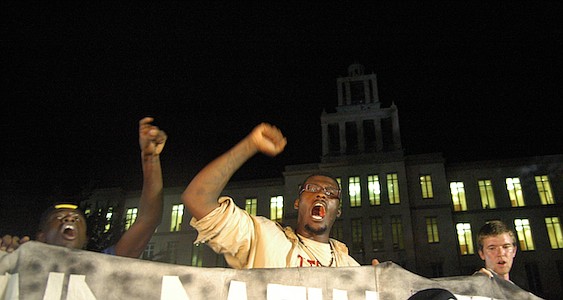
Sweating in the afternoon sun July 12, the day before he knew the verdict that was coming, Tampa writer Life Malcolm said he feared what would happen next if the words describing the defendant inside Seminole County Courthouse were “not guilty.”
“If George Zimmerman walks, it’s open season on black people,” he said, the day before the verdict was announced.
“This was a state-sanctioned murder,” Sanford resident Alma Pinkney said.
The trial of Zimmerman, a neighborhood watch leader who was accused of second degree murder in the shooting death of 17-year-old African-American Trayvon Martin, had in a moment focused attention to racial tension in Sanford and inadvertently resurrected ghosts of the past.
Some core facts of the night Martin was shot at point-blank range on Feb. 26, 2012, were not in dispute. Zimmerman had followed Martin, who was walking home in the rain after buying candy and iced tea at a nearby convenience store. Zimmerman told police dispatchers that Martin looked suspicious, walking in a hooded sweatshirt with a meandering gait in a largely white neighborhood. A minute later Martin was dead.
As the Zimmerman trial entered its final phase, jury deliberation, America passed an ignominious milestone. Sixty-two years earlier, in the town of Cicero, Ill., a mob of 4,000 burned an apartment building to the ground when they discovered a black family had moved into town.
A few years before that, Jackie Robinson had broken the minor league baseball color barrier in Daytona Beach. He was supposed to do it in Sanford, but threats of a mob lynching forced him out of town. Three weeks later when he returned to Sanford on a bus for one of the Brooklyn Dodgers’ minor league spring training teams, he only played two innings before Sanford’s police chief ordered him off the field.
Despite judge Debra Nelson’s ruling that race should not be discussed in the trial, for many outside it felt the same as racially charged killings in the area’s tumultuous past.
“What happened then is exactly what happened to Trayvon Martin in 2012,” Malcolm said.
For James Evans Muhammad, with the New Black Panthers, the verdict of “not guilty,” read just after 10 p.m. on July 13, added another bad memory.
“These young people had never experienced an injustice like [in the 1950s-1960s] before,” said Muhammad, the national minister for education of the New Black Panther Party. “They just got a taste of it.”
"Nationwide protest!" a group calling itself the Coalition for Justice for Trayvon shouted into a mass of protestors and media milling in a compound surrounded by low steel barricades and Seminole County Sheriff’s Office deputies. Many had started gathering outside the courthouse just as jury deliberations began July 12 to decide Zimmerman’s fate — somewhere between life in prison and total freedom. Thirty-eight hours later, they were still there.
The charge against Zimmerman, who admitted to shooting Martin, was second-degree murder. To the layman it’s a crime of passion charge; not sinister or plotted enough to carry the capital weight of first-degree murder, but intentional enough that a lesser manslaughter charge doesn’t levy enough punishment. For some vocal supporters of Zimmerman, neither law fit the crime.
“I changed my opinion after watching 90 percent of the trial,” Adam Teasley of Deltona said. “I believe he’s not guilty.”
Holding a sign that read “Not guilty,” Zimmerman supporter Susan Vargas described Zimmerman as a man who simply was concerned about his community.
But guilt was a difficult factor for prosecutors and defense attorneys to parse when considering identical evidence that they alternately used in favor of their own versions of the night in question. A crucial piece of evidence — screaming for help heard during a 911 call — was identified by opposing sides as coming from Martin or Zimmerman, depending on who was testifying at the time.
The jurors apparently had just as much difficulty finding a verdict. According to an account by the juror identified as B37 told to CNN’s Anderson Cooper, three jurors originally sought acquittal, two wanted a manslaughter conviction, and one wanted to convict Zimmerman of second-degree murder.
The wording of laws had muddled the idea of culpability for many, at least as defined by the law. In a mix of confusion among scatterings of vocal altercations between supporters of both sides outside the trial, former congressional hopeful and lawyer Jason Kendall inadvertently found himself in an argument with a Martin supporter, despite both largely agreeing with each other. His point: The law that defended Zimmerman shouldn’t exist in the first place.
“The law is what made it come to this,” Kendall said. “You should take the fight to ‘stand your ground.’”
In the wake of the shooting, Gov. Rick Scott had appointed a 19-member task force to examine the “stand your ground” law, which allows deadly force in self-defense or to prevent potentially deadly crimes. On Feb. 22 that task force recommended that the law remain largely unchanged.
The crux of the defense’s strategy focused on self-defense, and whether Zimmerman had needed to defend himself against Martin with deadly force.
In the end, after rounds of clarification questions and two days deliberating in isolation, the six jurors — five white and one black, all women — decided Zimmerman had lawfully defended himself. But to many outside the courtroom, “lawful” was far from “just.”
“It makes me ashamed to be a citizen,” protestor Keith Mack said. “What is my life worth?”
The reaction outside the courthouse that night grew more in a swell rather than an explosion of rage that some had predicted. But in other areas, namely New York City and Los Angeles, protests were far more vocal, drawing thousands in the streets calling for justice.
In Sanford, leaders called for calm. Mayor Jeff Triplett said that he hopes in five years the city will have made big steps forward toward peace.
An hour after the verdict, in front of the courthouse, New Black Panthers member Muhammad said that’s what he hoped Sanford residents would deliver.
“The best solution is not violence,” he said. “The best solution is rational and clear thinking.”