- April 7, 2026

-
-
Loading
Loading
The latest nano-invention from a UCF researcher could change the way everyday electronic devices such as cellphones, tablets, and even hybrid cars are powered.
Dr. Jayan Thomas may well be Central Florida’s very own Thomas Edison, constantly looking for the next great idea in the field of nanotechnology.
His Nano Energy-Photonics Group at the University of Central Florida has produced a variety of innovative new ideas: a holographic 3D TV using photorefractive polymers, thin flexible super capacitors, and specially coated lenses that block laser light, which could be used to protect pilots.
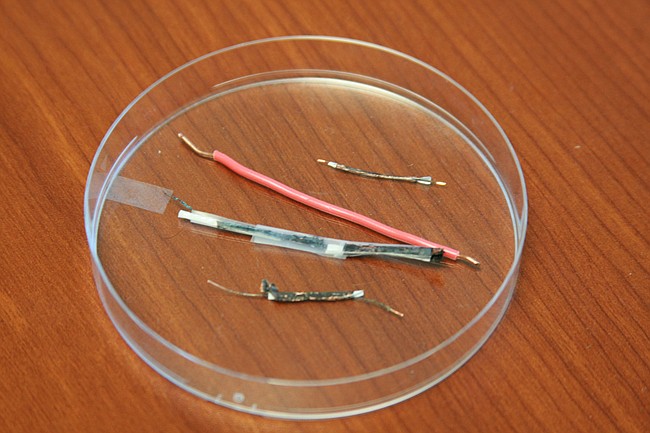
Now Thomas and his team have devised a way for electrical wires to not only conduct electricity, but also to store it.
“For us, it is a breakthrough, truly revolutionary,” Thomas said.
At the time of the breakthrough, Thomas was working on creating super capacitors with greatly increased energy storage capacity. Nanostructures “grown” on thin metal films increase surface area, thereby increasing storage capacity.
While out walking one evening, Thomas said he was thinking about his work on the flat super capacitors when a bundle of wires on the side of the road caught his attention.
“The thought just came to me, ‘What if we could just wrap the super capacitor around the wire and store the energy at the same time as transmitting it?’” he said.
The very next day he presented the idea to a student, Ph.D. candidate Zenan Yu. Together they began working to test Thomas’ idea.
Using copper wire as a base, they ‘grew’ tiny nanostructures on it, creating “whiskers” on the wire, just as they had for the flat super capacitor. The whiskers are then coated in a conductive alloy and again in manganese oxide, creating the first electrode. To separate one electrode layer from the next, the wire, with its ‘whiskers’ is wrapped in a polymer coating, much like regular wires. Then the final layer is added. Thomas and his team created another super capacitor, this time on flat copper foil, then wrapped it around the first layer, creating the second electrode.
With all the layers complete, the result is a single wire that both conducts and stores electricity.
As Thomas explained, the innovation could make it possible to greatly reduce or someday eliminate the need for batteries.
As a super capacitor, Thomas said the wire is currently only capable of producing a burst of energy, such as that’s needed to start an engine or device. Batteries are still needed to provide the slow release of energy needed to keep a device running over the long term.
But as research advances, new techniques or materials could make it possible for wires to store energy and be able to release it over a longer period of time, just as batteries do today.
Thomas said that the exciting part about this innovation is that the wire could be made so tiny as to be woven into fabric, creating wearable energy storage and transmission.
Imagine a cyclist gearing up for a long ride. She dresses as usual, checks tire pressure, makes sure she has plenty of water, and before she heads out the door, dons a very special cycling jacket.
Equipped with a flexible solar panel on her back, the cyclist’s jacket collects solar energy and, using the super capacitor wires woven throughout the material, stores energy that she can use to power her cell phone and cycling computer.
Such a future is “very much possible” according to Thomas.
The technology could also be used to store power collected by large solar arrays or wind-power generators.
Using super capacitor wires to provide stored energy, lithium-ion battery life could be vastly increased from an average of 1,000 charge/discharge cycles to nearly one million.
Cell phones and devices like tablets could readily adapt the new technology to extend battery life, Thomas said.
Vehicles including aircraft and hybrid-electric cars could benefit by using the wires to reduce weight and increase storage capacity.
But don’t go rushing to the store just yet; commercial development could take several years, depending on who is interested, Thomas said.
Several companies and industries have already made inquiries about the new technology, but Thomas said nothing has been signed yet.
“Some of the inquiries have surprised even me, so we’ll just have to wait and see where this turns up,” Thomas said with a smile.
“The recipe is all there, all they need to do now is cook it.”