- April 8, 2026

-
-
Loading
Loading
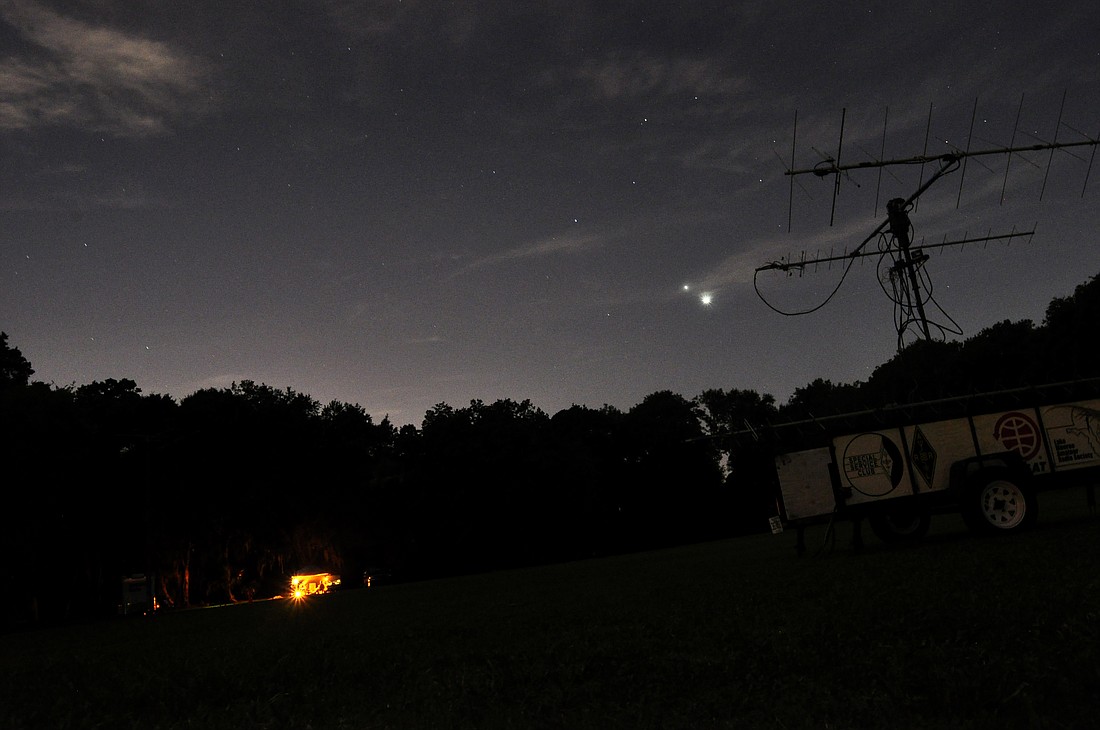
Silently the signals blast out into the fading blue above a football-field-sized gap in a forest, as two men perch on a park bench, racing a satellite about to dive below the treetops. At 9:14 p.m. on a Saturday night the radio dial spins with a slow franticness, click by click, searching for a sound that may never come.
“Key it,” the man in a gray t-shirt says in a quick burst of jargon. “It’s already down by the horizon.”
That flying radio station zooming past a backdrop of stars is on a 27-degree pass and it won’t be here for long. At this station, it’s all they’ll have to try to bounce a radio signal past the curve of the Earth searching for somebody, anybody.
The storm should have been here by now, with midsummer in Florida’s ill-famed swampy sizzle usually kicking up lightning as the sun packs up for the west.
Sometimes that heat cooks up a hurricane. The generators sputter to life and the radio operators go to work saving the world.
Stan Wood, call sign WA4NFY, used to fly airplanes past hurricanes. He remembers flying a dozen-seat King Air 200 on an emergency hop across the Gulf Stream as a swirling nightmare roared north from the edge of the Caribbean. He hoped beyond the dark clouds he could set down at the nicest restaurant in the Bahamas. It must have been closed by then, he thought, and his plane couldn’t carry much.
“We hoped we wouldn’t be too overrun there,” he said.
By the time he lifted off again, his plane had filled all but one of the dozen seats inside, everyone strapped in hoping to outrun that giant storm as its outer bands lashed islands to the south. With nowhere else to go, it was too late to question whether they’d outrun it.
These days, by the time Wood gets working, most often it’s already too late. The storm has already done what it was going to do. Wood’s job is what comes next, in the frantic aftermath trying to find out who survived and how to get to the ones in the worst shape. For Wood, long since grounded, the race is still against time.
Tonight, he's not alone in his quest to play the hero in this field in the middle of Winter Springs' Central Winds Park, surrounded by a dozen or so operators peppered in tents and trailers flung throughout this grassy open field. It's disaster simulation time.
The 39th annual American Radio Relay League Field Day is a 24-hour marathon of communication. From June 28- 29th the Lake Monroe Amateur Radio Society searched for every ham radio station in North America.
Radio chatter and code names filled the air as teams of operators attempted to reach as many of the 20,000 licensed ham radio operators as possible. Sixty foot high radio towers soar above the trees, spreading out across an open field. Satellite transmitters darted back and forth, searching for hunks of metal orbiting the planet at 4,000 mph. The activities in this part of the park were very different from the softball practice happening down the road.
Six stations, ranging from satellite trackers to Morse code machines, were set up to make contact with their unknown counterparts. Each one was dedicated to a certain frequency range or method of communication that could determine if they wanted to speak with someone in Phoenix, Arizona or aboard the International Space Station.
As Richard Schuyler Fischer slowly cranks the dial across the band he's spinning through, the static hiss clarifies into an almost alien squawk before fading away again. He tries to tune through it, but it's a lost cause. Every different band carries a different risk/reward ratio. For some, the chances of success span only a few minutes wide all day.
In some ways an anachronism, the scattering of radios across more than a century of tech is also a showcase of the benefit of holding onto old technology. One day a radio may save your life.
“It’s a hobby and it’s a way of life. It’s a hobby that became more than a hobby,” LMARS president Jim Diggs said.
Diggs became a licensed radio operator in 1953 when he was 13-years-old. If there’s a natural disaster, or an event that wipes out all other forms of communication, the eyes turn to people like him with the expectation that they have some way of reaching the outside world.
As he makes the rounds from station to station, Diggs checks up on the radio junkies. He moves to the Morse code station and quietly opens the door. Inside two men hunch together in a small trailer, one listening attentively to the spastic dashes and beeps, methodically calling out their origins while the other logs every word. They could do this for hours, Diggs said proud and satisfied.
Another trailer contains the twenty-watt station that made over 700 contacts during the competition. A teenage boy is laying in a hammock after a long day of operating. Sitting to his right is an older man speaking into the microphone of the twenty watt radio, giving his call sign that every member bore somewhere on their body as an insignia and second identity.
“November Echo four Hotel. Six Alpha North Florida,” he says into the microphone. The teenager, lounging in the hammock while looking at his phone, begins to say something out loud. He’s then sharply silenced by his elder, annoyed with the interruption. There’s no room for chit-chat while on the job.
Background sounds of static and frequency tuning dwarf all other noises as an operator turns the radio’s dials. Finally after a few attempts a piercing metallic voice can be heard giving the operator a call sign and location. By late Sunday morning LMARS had made contact with forty nine states, except Wyoming, Diggs said.
When taking a break from mass communication, they spoke excitedly about their favorite types of equipment to use. Good natured locker room banter occupied their time. It was this type of connection that attracted members like Dan Martin to LMARS and why he looked forward to the Field Day test. “It’s a competition, but it’s the camaraderie that brings us out,” Martin said. They were having fun.
Behind Martin lies a satellite transmitter capable of reaching the International Space Station. The space age technology sits calm one moment, waiting for directions from Lou McFadin, a retired NASA employee who helped design and build satellites for the space agency. Minutes later it finally receives the coordinates that will connect a group of radio amateurs with men no longer on this world.
They pass through the night, many working in shifts. In one of the more luxurious trailers, with Al LaPeter spinning the dial, a foam pad and pillow lay on the floor. For some, it's a full-blown endurance test with a 24-hour badge of honor at the other end.
Nearing midnight, the board read more than 1,000 contacts — nowhere near the goal — with a long time to go until the sunrise.
At around noon the next day, the group hears thunder and begins to pack up out of fear of lightning strikes.
Two thousand contacts later, LMARS proved to themselves that they can reach anyone, grasping as far as the stars, readying for a disaster in their own backyard.