- April 1, 2026

-
-
Loading
Loading
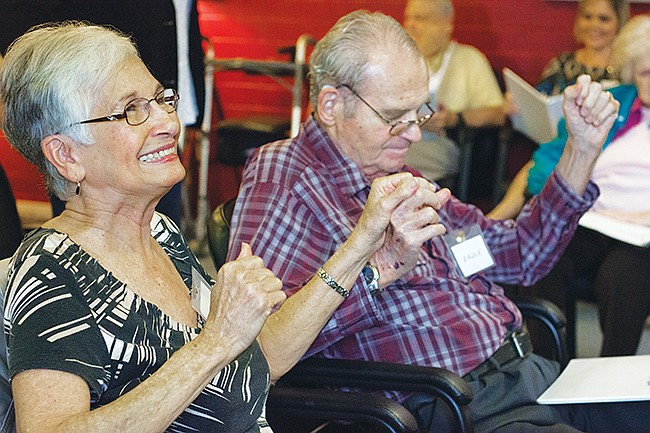
Every Wednesday morning is date time for Cherry and Bruce Urich. They get gussied up ready to dance and sing the mid-week blues away. Cherry looks forward to boogieing down to “Rock Around the Clock,” while Bruce prefers the patriotic salute of “God Bless America.”
After three and a half years of marriage, Cherry says the couple is still in their honeymoon phase.
The pair pack up Bruce’s walker and head out the door to Central Christian Church in Orlando to make it there by 10 a.m. sharp each Wednesday. In a back room of the Ivanhoe-area church, they meet up with six to 10 other couples for rehearsal of the Central Florida Community Art’s Musical Minds Choir.
“We forget all of our cares, all of our challenges,” Cherry said. “It’s a moment in time I make sure not to miss each week.”
The Musical Minds Choir is made up of adults experiencing the early stages of memory loss, dementia or Alzheimer’s disease, and their caregivers. It provides, as CFCArts calls it, “music for the health of it.”
It’s one of many music-based groups created by CFCArts, an organization created in 2010 with the goal of enhancing the Central Florida community’s quality of life by making the arts accessible and affordable for all. Memory-impaired seniors are one of the newest groups CFCArts has targeted, starting the Musical Minds Choir last fall.
The Alzheimer’s Association of America recognizes music therapy as a powerful tool for those with memory loss.
“Music has power — especially for individuals with Alzheimer’s disease and related dementias. And it can spark compelling outcomes even in the very late stages of the disease,” reads the Alzheimer’s Association website.
“When used appropriately, music can shift mood, manage stress-induced agitation, stimulate positive interactions, facilitate cognitive function, and coordinate motor movements”
Kevin Harris, director of the Musical Minds Choir, says he sees those shifts every week at rehearsal.
Pairs shuffle in, two-by-two, parking walkers by the wall before taking a seat. They pick up provided binders and flip through the musical selections to be sung that week. Most pieces had their heydays back in the ’40s, ’50s or ’60s. Harris said he intentionally picks songs that will have an emotional connection with the choir’s members, bringing back old memories.
“It’s not only intellectual, but an emotional connection that people make with music that allows it to be special,” Harris said.
For choir member Barbara Ditmars, the songs that hit home the most are “Hello, Dolly” and “Que Sera, Sera.”
“It’s bringing the time back to when I was a little girl,” Ditmars said. She attends rehearsals each week with her caregiver Tiffany, sitting in the back clapping and singing along, a smile ever-present on her face.
Baritone Ed Haddad adds a bellowing accompaniment to the choir, his voice echoing heavy through the room. A self-declared “MIP” – or “Memory Impaired Person” – Haddad said music plays an important role in keeping the brain active.
“It calls out the artistic parts of peoples’ brains,” he said. “… All these kinds of things engage parts of the brain that otherwise, if you’re just sitting around on the couch, wouldn’t have been engaged.”
Before rehearsal starts, Ed takes a seat behind the piano to provide an improvised soundtrack as his fellow choir members arrive. When the clock strikes 10 he gets up to hand the keys over the director, to the protest of his classmates.
“Don’t stop!” Cherry urges from the front row.
“Nobody put any money in the (tip) jar,” Ed said.
“Where is the jar?” asked choir member Dennis Dulniak peering over at the piano from across the room, pretending to look for the jar that doesn’t exist.
“That could be the problem,” said Ed with a laugh. “But you know, sometimes you forget things.”
Laughter fills the room as Ed performs his final encore.
Harris said he’s worked to create a “safe place” during Musical Minds rehearsal where Ed can happily freestyle on piano, Cherry can cut a rug in the back of the room without a care, and no one has to apologize for forgetting the words to the songs.
“I make a point to remind them almost like a mantra that this is a safe place,” Harris said. “… I want to give them an opportunity to be who they are and be OK with where they are on their journey.”
As the swaying melody of Doris Day’s “Que Sera, Sera” fills the room, Cherry reaches over to hold Bruce’s hand. Parkinson’s disease makes his grip stiff, but they clasp hands tightly as she sings to him, his face down, glued to the music, lips firmly shut.
She reaches her other hand out to stroke his cheek, coaxing his gaze upward as she sings.
“When I grew up, and fell in love. I asked my sweetheart, ‘What lies ahead? Will we have rainbows, day after day?’ Here's what my sweetheart said.”
Bruce raises his eyes to meet hers for a fleeting moment as a warm, closed-mouth smile breaks over his face.
"Que Sera, Sera,” he sings out, nodding along for a moment before turning his head back down to the page, lips falling still again.
Other members hold hands swaying back and forth in time. “Whatever will be will be. The future's not ours to see. Que Sera, Sera. What will be, will be."
Small moments like that are what the choir is all about, Harris said.
“It’s heartwarming and heart-wrenching at the same time,” he said. “…It shows how important it is to create opportunities for them to connect with us and their loved ones.”
For Cherry, it gives her an opportunity to have a weekly date with her doting husband. She said Bruce didn’t know he had Parkinson’s when they married three and a half years ago.
“He said he wouldn’t have married me if he’d knew. He wouldn’t have wanted to be dependent,” she said.
“But I waited 30 years for him … I’m so glad he did.”