- April 2, 2026

-
-
Loading
Loading
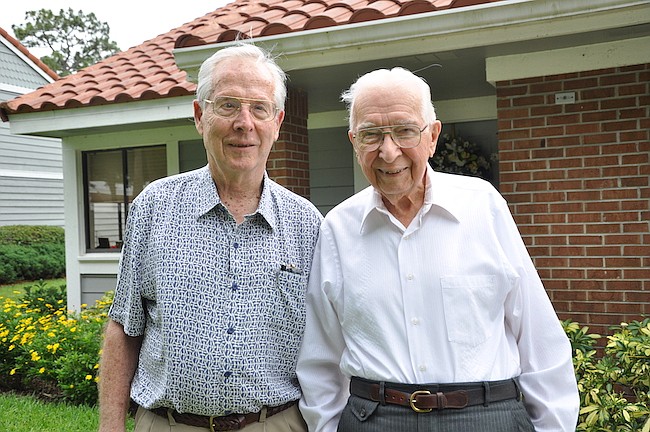
Even a war that threatened to tear the world apart can somehow bring people together. For two seniors living in Longwood, a world war is simply water under the bridge – despite the two men fighting for opposing sides more than 70 years ago.
Ken Shappell, 91, and Wolf Von Lersner, 89, first met in April of 2002, neighbors in the Village on the Green senior living community in Longwood. What the two men didn’t realize however is that their paths had crossed once before, brought to the same place in the closing months of World War II: the Rhine River in March 1945.
Both men served their countries in battle, with Ken fighting for the U.S. Army and Wolf fighting for Germany.
“Wolf and I were shooting at each other across the Rhine,” Ken said.
“We were lousy shots – that’s why we’re here,” Wolf said with a laugh.
The two former soldiers have been friends ever since they learned of each other’s military service.
“We were talking back and forth, next thing you know Wolf says he was our prisoner,” Ken said.
Pinned Down
Wolf still remembers the Allied bombing raids over Berlin – he was living there at the time.
Like most young boys in Germany during 1943, Wolf’s life primarily focused on protecting his home. He was taught how to load anti-aircraft guns at the age of 16, like all school children his age. One year later he was retrained to be a grunt in the German army.
But through it all, Wolf insists he was never afraid.
“We were all together,” he said. “I wasn’t alone.”
Come March 1945, World War II was coming to a close. The Allied forces were pressing in on the German homeland, looking to cross the Rhine River that formed a natural border with Belgium and France on one side and Germany on the other. Almost every last bridge was destroyed that crossed the river, except one: Lundendorff Bridge, also known as the Bridge at Remagen.
Wolf and his battalion were given one mission: clear that bridge head and keep the allied forces from crossing the river.
“It was like a moat for a fortress,” Wolf said.
The bridge wasn’t destroyed sooner because of the 50,000 troops that were still on the other side from the Battle of the Bulge, Wolf said. Gen. George Patton’s army took advantage of this, and pushed to cross over the bridge.
“According to history later on, Hitler apparently went bananas when he heard that that bridge was still standing,” Wolf said. “He said ‘I want that bridge out. I want that bridge head gone.’”
In early March of 1945, Wolf and his battalion took a last stand to keep the Allies away. Wolf said he remembers the battle well.
“We had a little bit of a firefight back and forth. We saw some infantry men running around and we got some fire from them, from him,” said Wolf, pointing at Ken and laughing.
“The next day the skies cleared up and we were put under pressure. The P-52 Mustangs kept us completely under cover. There was nothing we could do. We didn’t have any heavy arms or anything.”
Patton brought 20,000 men over the bridge in just 10 days. The bridge later collapsed after heavy trucks attempted to drive over the damaged foundation, but Patton had already built a pontoon bridge nearby to keep the troops and resources coming.
Meanwhile, Wolf had been cut off from the rest of the army, pinned down with a group of 11 or 12 men with no food and only one machine gun that swallowed too much ammunition.
“We tried to retreat,” Wolf said. “It got tighter and tighter. After about two or three weeks, I became a POW.”
“We were cornered and cut off from everything. That was the end of the war.”
Music for morale
Roughly two years earlier and almost 4,000 miles away, Ken was attending Lebanon Valley College in Annville, Pa. studying music. He played a little bit of every instrument, but favored the clarinet and the saxophone.
In 1943, Ken was drafted into the U.S. Army thanks to an ironic twist.
“My wife-to-be worked at the draft ward,” Ken said. “She sent me the draft notice.”
“A nice gesture,” Wolf said with a grin.
His Army camp in Harrisburg, Penn. learned he could play music, so Ken was put on a train to Salina, Kan. to join the Smokey Hill Army Airforce Band. Ken was 18 at the time and spent close to two years in the band, traveling throughout Kansas and entertaining Army camps with music.
But in 1945, the song came to end.
“This finally caught up with everybody,” Ken said. “They decided to break up these long-term, morale-boosting outfits and ship us off to the infantry.”
Ken was sent off to Texas for a brief stint of training before he was on his way to Germany.
“I had six weeks of training,” Ken said. “I knew which end of the rifle a bullet came out of.”
The new grunt was sent to replenish the 44th Armored Infantry Battalion following the Battle of the Bulge. His group later joined with Patton’s Army in March 1945, where he caught his first glimpse of the Rhine River as it was being crossed.
Despite being enemies, Ken noted that the German citizens always treated U.S. soldiers better than the French.
“I don’t know if they were afraid of us or what,” Ken said.
Nazi Germany would give its unconditional surrender just two months later, ending the battle for Europe.
Swimming the Rhine
Wolf meanwhile spent the next year as a prisoner of war in France. But despite the war being over, survival was a struggle in the prisoner stockade.
“There was an order from Eisenhower after they found all of these concentration camps and saw starved people,” Wolf said. “He ordered rations to be reduced. I had one bowel movement in a month. That’s how much they fed us. That was terrible.”
Wolf was put to work in the Champagne province building tent cities for demobilization of army outfits for three to four months. In early 1946, the French were looking for people to work in agriculture in the Alsace province, so Wolf volunteered and was taken to a stockade not far from Strasbourg and the Rhine River.
That’s when Wolf planned his escape.
Guards would shuttle the workers back and forth between the farm and the stockade. All Wolf had to do was devise a story and make a run for it.
“I told a woman that ‘my guard is here,’” Wolf said. “I told her before they actually showed up.”
Wolf made his move, escaping the farm that night with another worker by the name of Manfred.
“We heard them let the dogs loose, so we jumped into a creek,” Wolf said. “We hoped they wouldn’t get a scent.”
The two runaways walked for two hours in that creek, and the sound of barking dogs grew fainter and fainter.
Wolf and Manfred walked in a semicircle around the city of Strasbourg, crossing a French minefield before they reached the ice cold Rhine River. It was while Wolf was swimming through the frigid water that he doubted his own survival.
“I thought I wouldn’t make it,” Wolf said.
They both managed to reach the other side, hanging their clothes to dry in a nearby clearing in the woods. They would have to walk at night and sleep during the day to continue their escape, as they were both still wearing their prisoner uniforms.
While walking along a country road, Wolf and Manfred stumbled upon a roadblock set by soldiers and were spotted.
“After all this, we didn’t want to go back,” Wolf said. “We ran into the fields. I went to one side, my buddy went to the other side.”
Wolf can still recall being shot at, hitting the dirt and waiting for the sound of reloading rifles so he could get back up again and keep running.
“I got away, but my buddy somewhere got caught,” Wolf said. “He went back to the stockade.”
Old war buddies
Ken and Wolf would ultimately find their way back home. Wolf came to live in the U.S. in 1956 with his wife and worked for Campbell Soup Company for 30 years. Ken would later marry the same girl that sent him the draft notice and went on to work at Textile Machine Works before working sales at Hitchiner Manufacturing.
Both are now enjoying a long retirement.
The two former soldiers now spend their days reminiscing about their war years. Though coming from dramatically different backgrounds, both realized something they head in common: a duty to serve and protect their home, along with a distaste for war in general.
“All I can tell you is its wrong,” Ken said. “It doesn’t solve anything.”
“It just causes problems,” Wolf said.
As the two veterans sit together on the couch and think back on the Battle of Remagen that ultimately led to the end of the war, they can agree on something else: it’s all water under the bridge.