- March 16, 2026

-
-
Loading
Loading
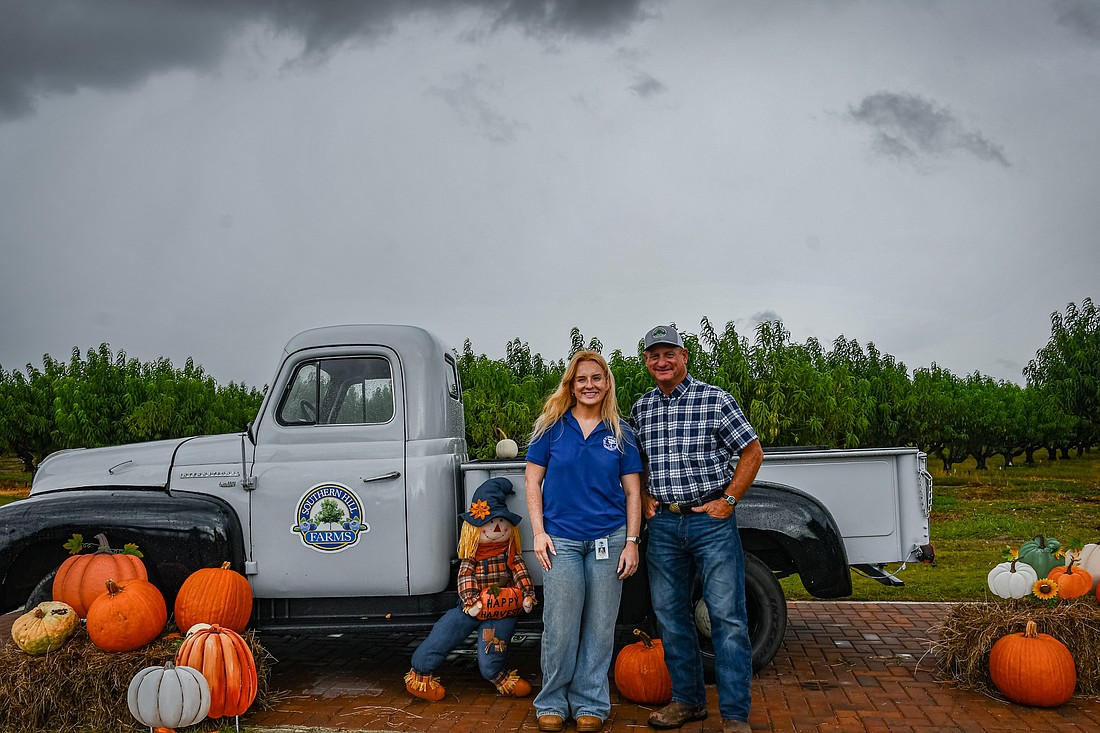
Southern Hill Farms owner David Hill planted his first blueberries in 2012.
And because the delicate fruit requires careful attention in the colder months, he spent many nights in his truck next to the plants. When the temperature of the blueberries hit 45 degrees, he set an alarm every hour to wake himself up and check them.
When the temperature dropped to 35, he set the alarm for every 15 minutes.
He took a flashlight and checked the plants, then cranked up the water to protect them from freezing.
“That was rough,” Hill said.
Three years later, Hill found the St. Johns River Water Management District Agricultural Cost-Share Program and applied for a partnership. His farm now has two weather stations, remote sensors and the newest addition — a well pump automation.
Taylor Maxwell, agricultural partnership representative at St. Johns River Water Management District, said the farm uses the cost-share program for funds to advance technology. The program has two goals: conserve water and improve water quality.
The district strives to hold farmers accountable as well as push for proper practices of water conservation and the reduction of fertilizer going into water bodies.
The agriculture team accepts applications year-round for the program, and partners apply for 10- to 15-year contracts. Every six months, the partners must report water usage to St. Johns.
Maxwell said St. Johns references historical data of water usage to see how much water a partnership will save. It must cost $3 per kilo-gallon of water saved for the district to approve a program.
The district chooses to fund the project based on its value, not the amount of water. She said this helps smaller farms obtain approval. In the past year, the agriculture team has funded 40 partners.
Depending on the situation, a farm might simply need an upgrade to its equipment, but other cases require brand-new technology.
When Hill planted his 40 acres of blueberries, he needed technology to help manage them as well as the farm’s strawberries, blackberries, peaches and sunflowers.
After running the numbers, St. Johns determined adding the well pump automation to Southern Hill Farms is worth the cost.
Southern Hill Farms’ well pump automation is expected to be completed by December, Hill said. The technology will be helpful to protect plants, especially blueberries, from freezing.
“We’ve got multiple crops that we’re doing the same thing to,” Hill said. “That’s the issue. When you have so many … it’s nearly impossible to get to each one at the same time to turn them off.”
With only 15 employees who work on the 120-acre farm with five different types of crops, it’s a large task to manage. That’s why the well pump automation funded through St. Johns’ cost- share program will be helpful.
Southern Hill Farms has remote sensors in the field that track the temperature of the plants. Hill and the workers use the sensors to calculate an incoming freeze or frost. A freeze is easy to calculate based on expected temperatures, but a frost is challenging because of the extra factors, such as humidity.
The well pump automation will allow Hill to control the water distribution from his phone, rather than standing next to the machine and automatically turning on the water. This helps with the timing of turning it on and off, which saves water.
“You have to get the plant wet, and it takes several minutes for the plant to warm up, and that’s the part where you can damage the berry,” Hill said.
Hill uses the sensors in the field to track the temperature of the plants, so he knows to be alert for danger to his plants.
The sensors show him two “bulbs.” The wet bulb is the temperature the plants think it feels like, and the dry bulb is the temperature you feel. Hill looks at the wet bulb.
“It’s kind of like when you take a shower, and you’re wet and you step out, often you’re cold,” Hill said. “But if you weren’t wet, you wouldn’t be as cold.”
For example, if the temperature outside reads 38 degrees, but the wet bulb reads 32 degrees, he will turn on the water. To protect the blueberry, he has to get it wet before the temperature of the berry is too far below 32 degrees.
The blueberries are highly susceptible to damage from freezes during December and January because they are not ripe.
“If you turn the water off too early, you do a lot of damage,” Hill said.
The strawberries are less delicate, because they are ripe and have a higher sugar content. Strawberry picking season begins in December.
Blueberries also must fully be coated by water, which uses more water. Every minute the machine runs, 440 gallons of water is pumped out. The well pump automation will help reduce the amount of water wasted since it can be turned off through a phone.
Using the improvements at Southern Hill Farms through the district’s agricultural cost-share program more than 15 million gallons of water are saved every year. Hill said the farm does its best to reduce water waste, but the farm is located on sugar sand. Any water that isn’t soaked up by plants will sink directly through to the aquifer.