- March 16, 2026

-
-
Loading
Loading
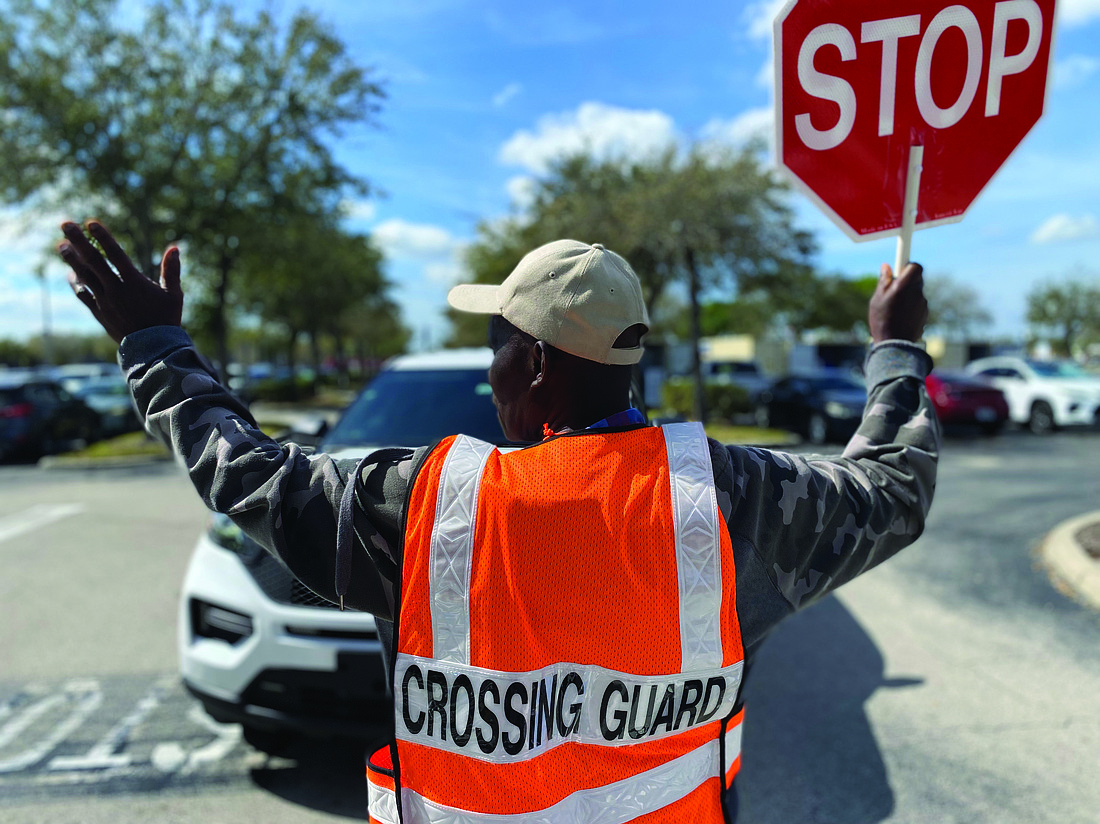
As children across Orange County head back to school, the people behind their safety on the streets return to work.
Orange County Sheriff’s Office is back to actively hiring school crossing guards for the upcoming school year.
OCSO is looking to fill 75 vacancies of crossing guards in two weeks before Orange County Public Schools start on Monday, Aug. 11, said Elaine Tirando, school crossing guard supervisor.
“So although the number is high right now at 75, we’re pretty confident that the number is going to go down to at least half of that,” she said.
OCSO has three scheduled training sessions before the school year starts and intends to use those to fill slots.
According to OCSO’s listing, there are 10 qualifications to become a crossing guard, including being 18 years old or older; passing agility tests; an occupational health exam; a vision test; and being able to work with children in a high-traffic environment.
Crossing guards are needed throughout Orange County but especially in high-growth areas such as Horizon West.
“The Horizon West area is booming right now,” Tirando said. “There’s a lot of homes being built, apartments, schools being built, so that brings a higher need right now. … We have vacancies throughout the county. It’s just that some areas sometimes are a little bit more challenging to hire for.”
Tirando said crossing guards are crucial to the safety of students who walk to school; OCSO constantly is having to hire for the position.
“It’s a split-shift position, so the hours vary depending on the school that school guards are placed at, but the average hours for an elementary school crossing guard would be from 8 to 9 every morning and 2:45 to 3:45 in the afternoon,” Tirando said.
OCSO has about 150 crossing guards who work at both elementary and middle schools, so they end up working four hours per day, but the Sheriff’s Office only needs people for the two-hour role now. Because of the nature of the hours, primarily retirees apply. Often, they see it as a way to “get out of the house and to serve their community,” Tirando said.
At the end of each school year the Sheriff’s Office loses about 20 crossing guards, but there are plenty who come back each season.
“I actually have one lady, her name is Anne, and she’s been with us (more than) 40 years as a school crossing guard,” Tirando said. “She’s the longest one we’ve had. But we do have other longevity. We have a lot of guards with us for 10, 15, 20, even 25 years. But that one guard that we have, we always talk about her every year when we meet with our returning guards.”
Anyone who applies for the position only has to go through one training session.
“Usually, it’s an all-day thing, because we do training and orientation the same day, so they’re here from 8:30 a.m. to 5 p.m.,” Tirando said.
The training day is divided into four main parts. They begin in a classroom-like setting, where the new hires are shown five videos that have been approved from the Florida Department of Transportation. New hires also are shown a PowerPoint presentation before they go outside and practice being a crossing guard.
“We practice being a crossing guard right outside of our building at the crosswalk,” Tirando said. “They each take turns doing that, until they feel comfortable enough, and they are graded on that according to the performance checklist standards that we have to adhere to. Once they do the practical training outside, they come back inside and they complete a 30-question written test.”
New hires are required to pass the written test with at least a 75% to continue. If they don’t pass on the first try, they are able to retake it once more before OCSO disqualifies them.
After trainees complete the written test, they transition into the orientation part of the day and have everyone complete paperwork and grant them the necessary equipment.
Once hired, staff members don’t have to redo the day-long training process, but returning crossing guards go through a four-hour annual refresher after each school year.
“We go over the things that they need to just keep in mind when they’re out there — like drinking enough water, for example, hydrating before even arriving to the post, making sure they wear sunscreen, making sure that they wear their sunglasses to shield their eyes and their hats to protect their heads,” Tirando said.
Tirando emphasized the importance instilled on crossing guards to keep themselves safe while experiencing the blazing rays of Florida’s sun.
After the crossing guards are hired, OCSO ensures their safety by providing them with the proper equipment, such as a reflective vest, a stop paddle, a whistle, gloves, a hat and their ID. They also give winter jackets and hooded raincoats in case of inclement weather.
“Their equipment does play an important role in keeping them safe, because (the vest is) also very bright, and that’s for a reason,” Tirando said. “We want them to be visible.”