- March 20, 2026

-
-
Loading
Loading

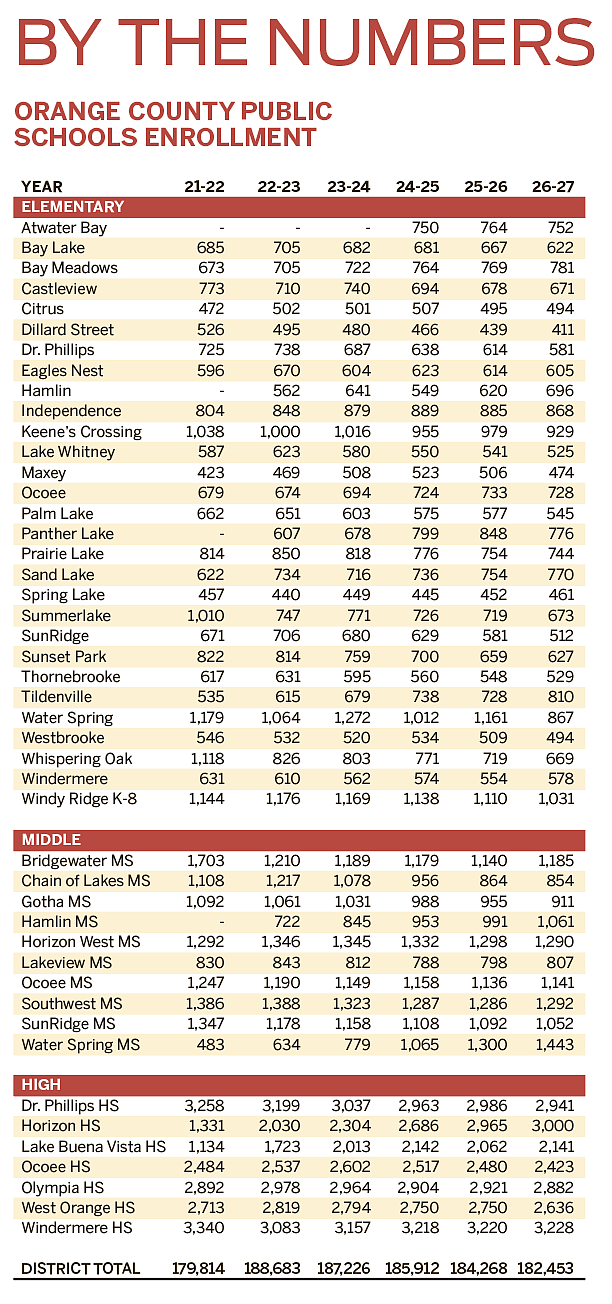
Orange County Public Schools is facing the loss of an estimated 3,100 students for the 2025-26 school year, resulting in the loss of $27.8 million in state funding that will have impacts on teachers and the district’s budget.
This will be the largest drop in enrollment since the COVID-19 pandemic when the district’s overall enrollment in traditional schools went from 192,810 students in the 2020-21 school year to 179,814 students in the 2021-22 school year. The enrollment somewhat rebounded to 188,683 students in the 2022-23 school year and has fluctuated since, with 185,912 students being enrolled in traditional schools this school year.
While some areas, including Horizon West, are booming, others are experiencing aging populations that no longer have school-age children. As a result, Scott Howat, chief communications officer for the district, said the district is seeing a decline in kindergarten registrations in some areas of the county.
The estimated 3,100 students exiting the district is a result of declining birth rates as well as more families taking advantage of the Family Empowerment Scholarship for Educational Options, which is a state-funded universal private school scholarship open to all K-12 students. The scholarship was expanded from only low-income families to all K-12 students in 2023.
Between private schools, charter schools, home education and other educational opportunities, Howat said the district is facing more competition to keep students in traditional public schools.
He said the district hopes families will choose to send their children to the local neighborhood traditional school because it’s the best option for their child, but there are a multitude of choices.
“We just want to make sure parents know traditional public schools and what we’re offering their children is a safe, high-quality learning environment where they can get everything they need to be successful in school, academically, but then beyond school, post graduation,” Howat said.
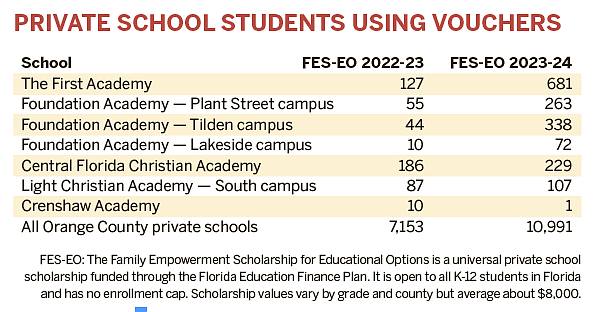
More private schools are accepting the Family Empowerment Scholarship for Educational Options, which, on average, provides $8,000 per student for a family to send their student to private school. Other scholarships can help families fund home education or other educational opportunities.
According to Step Up for Students, a nonprofit providing scholarships for educational options, the Family Empowerment Scholarship for Educational Options began in 2019 with 17,724 students as a means of relieving the waitlist for the Florida Tax Credit Scholarship, which provides, on average, $8,000 scholarships to families to send their children to private schools. In the 2024-25 school year, Step Up funded 253,370 students to attend private schools across the state through the scholarship. Between the Florida Tax Credit and Family Empowerment Scholarship for Educational Options, Step Up has helped send 307,609 students to more than 2,200 participating private schools across the state.
In Orange County, Step Up provided 10,991 Family Empowerment Scholarship for Educational Options in 2023-24, compared to 7,153 in 2022-23. Step Up will not have the data for the 2024-25 school year until June.
Some private schools, including Foundation Academy, said there are families at the school taking advantage of these scholarships, but the demand to attend the school already was in place before the scholarship program was expanded. Foundation President David Buckles said the K-12 private school saw a record number of applications this current enrollment season.
“The hard part is to tell these families who are desperately trying to use the scholarship money to get into your school that there’s no space,” he said. “We have seen the inquiries up.”
The increased demand for private educations also has resulted in more competition for qualified teachers, whether in public or private school, Buckles said.
Although a private school might be accepting more scholarships, the increase in scholarships could be from students already enrolled in the school using the scholarships to offset the cost rather than new students coming into the institution.
The primary concern with the loss of students is the impact it can have on teachers.
School staffing is based on the number of students in each grade increment. Staffing is divided by kindergarten through third grade; fourth grade through eighth grade; and ninth grade through 12th grade. Howat said if a school has enough students for five kindergarten teachers one school year but expects to have 40% fewer students, the school would have to eliminate two kindergarten teachers.
Howat said every effort is being made to ensure the district does not lose teachers.
“We don’t want to lose any teacher who is serving our students in a significant way at whatever level,” Howat said. “We don’t want to lose teachers, so we’re doing everything we can on our end to retain them. We’re offering visual job fairs in May where teachers who maybe have been displaced because there wasn’t enough students at that school will be given the opportunity to see those other opportunities to gain a position at another school.”
After the first 12 days of the school year, the district looks at enrollment at each school to determine where teachers need to be reallocated. Some schools might have more students show up than others, which could mean teachers will have to go to a different grade level or even a different school to meet the needs of each school.
“We are constantly looking at that … to try to shore up the resources we have, and if we end up with more students than we have teachers, we’ll certainly go back to those that might still be waiting for a position and tap on them if they are still available and haven’t already been hired by other schools or other principals,” Howat said.
Districts receive state funding based on student enrollment. Although the state Legislature could increase per pupil funding, the decline in student enrollment still could result in a funding reduction to the district’s budget, Howat said.
“If (the state) is not giving us enough of an increase (in per pupil funding), it might not be enough to cover the mandatory costs we have,” Howat said. “I like to compare it to your paycheck. You never look at your gross. You always look at your net. … For us, we have to look at not the gross of what we’re receiving but the net when they take out retirement, utility increased costs, all the things that are put on top as far as expenditures. What do we have left … to put it into the classroom, put into teacher salaries, put into benefits.”
The district is looking at where cuts can be made at the district level to avoid teacher layoffs and other direct impacts to the classroom. Superintendent Dr. Maria Vasquez has directed district administration to cut their budgets by 2% across the board. Howat said district administrators will be looking at whether vacant positions can be eliminated as reducing personnel is a way to decrease expenditures. The district also will look at programs that could be reduced.
“Each of the chiefs at the district level will be looking at their budgets to reduce, and that’s not at the school level,” Howat said.
The decision to move a child from a traditional public school to another educational institution can be the result of a multitude of factors from lack of transportation to what they’ve seen at the classroom level to scheduling flexibility and more, Howat said.
“It becomes very personalized to the family,” Howat said. “In some cases, we need to know is it, in fact, perception? Is it the perception of middle school that’s causing parents to bypass middle school to go to private school for middle school and then come back in high school? We see some of those trends in our data. … We know families don’t choose a school district, they’re choosing their school, and we just want to ensure that parents know we feel we are the best choice for their child. We want to show them that.”
To combat perception and spread awareness of what traditional Orange County public schools have to offer, the district has entered a partnership with Caissa Public Strategies LLC, a Memphis, Tennessee-based third-party recruitment agency. The contract is a performance-based contract with an agency that has eight years of experiencing helping school districts in 27 states recruit students to traditional public schools, Howat said.
Howat said Caissa will receive $935 for each formerly enrolled OCPS student who re-enrolls in OCPS and attends a district-operated school for 30 days. The funding will come from the per-pupil spending, which Howat said will allow the district to net $7,065 for each student. If the agency’s efforts does not result in any students being re-enrolled in OCPS, it will not be paid.
“If we had 1,000 students that were recruited back to our schools, they would get roughly $935,000, but we would get (about) $8 million, which could go towards preserving teacher jobs and positions throughout the district,” Howat said.
Howat said historically, the agency has a record of every student that is re-enrolled staying with the district for 3.4 years. For every student re-enrolled, the agency will receive a one-time payment of $935, but the district will receive a yearly per-pupil allocation for each year the student remains enrolled in OCPS.
With the agency starting its work now, the district might not see the fruit of that labor until the start of 2026-27 school year as many families already have decided where to enroll their student for the 2025-26 school year. Howat said “the sky is the limit” on how many students the agency might be able to recruit back to OCPS.
The district is not solely depending on the agency to help boost enrollment. The district also is working with school principals on how to best market their schools and share with the community what programs they have to offer.
“We’re being aggressive in order to try to bring students back again, in order to preserve teacher jobs, we want to make sure that all of our teachers who want to work as teachers have a job,” Howat said.
Howat said the district is encouraging families to register their kindergartners and pre-kindergartners for school now rather than waiting until closer to the start of next school year. As more families register their kindergartner, the school can have a clearer picture on how many teachers will be needed. Families then also will know who their teacher is in advance and can participate in activities welcoming the new pre-K and kindergarten students.
“If you had enough students last year for five kindergarten teachers, but this year’s class of kindergartners, you might have as many but only 60% of them have registered, then that school could be in jeopardy of losing two teachers when in reality, they might need those and they just don’t know it because the parents have not registered them,” Howat said.
The district also is encouraging any families who are moving to register their children at their new school so schools can determine personnel.