- March 20, 2026

-
-
Loading
Loading
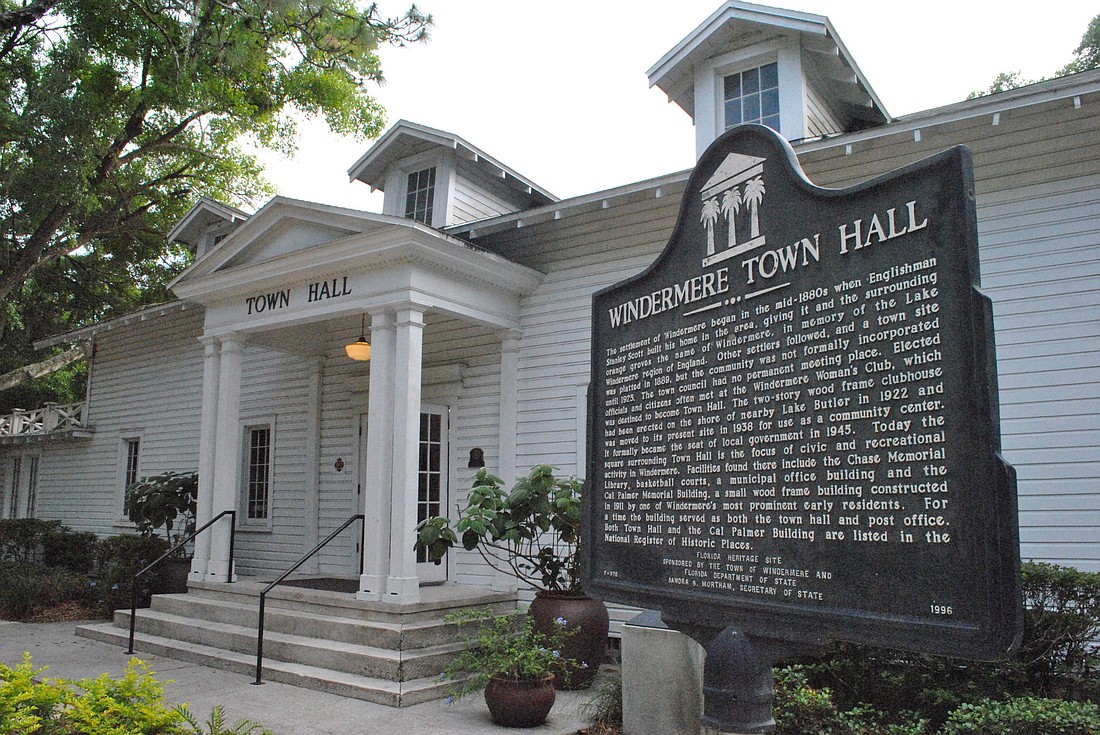
Windermere Town Council unanimously approved securing up to $2 million in funding through the Florida Local Commercial Paper Program.
Town Manager Robert Smith said the financial funding approved during Town Council’s meeting Tuesday, Nov. 11, will help bridge the temporary liquidity gaps between expenditures, payroll and vendor payments versus incoming revenues.
Town staff provided a resolution regarding this matter during a special Town Council meeting Tuesday, Nov. 18, for council approval.
The town of Windermere receives most of its annual revenue from Orange County ad valorem taxes, which typically are distributed in mid-December each fiscal year.
The town is proceeding with multiple reimbursable infrastructure projects, and those reimbursements typically are received 60 to 120 days after expenditure.
The town has received numerous state appropriations and grants from various agencies, including the Hazard Mitigation Grant Program and Federal Emergency Management Agency.
Smith said the town has been waiting for about $800,000 from the state and federal government for more than 90 days.
As a result, there is a need to secure additional temporary funding to ensure the town remains in good standing with vendors.
Smith said typically in a contract with vendors, the town has 30 days to pay the vendor.
“Right now, we’ve pretty much committed all of our reserves, because we’re still waiting for ad valorem to come in, all the ancillary taxes,” he said.
He said the town has about $1.2 million in reserves, most of which is committed to pay for infrastructure projects.
The Florida Local Commercial Paper Program functions similarly to a line of credit but also offers the advantages of pooled rates, no amortization requirement and full compliance with municipal debt limitations. Funds may be borrowed and repaid within each fiscal year as needed, with no early payoff penalty. There is an option to renew participation annually for up to five fiscal years.
Smith said with an interest rate of about 3.78%, if the town takes out the entire $2 million, the interest would be about $6,800 per month.
“We need the money in order to make sure we stay afloat while we have all these projects coming in at one time,” he said. “We didn’t anticipate this happening. … What typically happens is we pay the vendors, then we have all the canceled checks, we send it to the state for them to approve it, and then they send us the money. It’s just bad timing with everything coming in at one time. … If we would have known that all these projects were coming to fruition at one time and then having to float money more than we actually thought it was going to be not being reimbursed, we would never want to.”
Council member Andy Williams said he was caught off guard by the proposed funding request.
“I understand that it was just the perfect storm; they’ve all collided at once,” he said. “When it came onto the agenda, I was kind of caught off guard on it because I’ve been preaching to everybody that we’re looking around at other municipalities all struggling, and we’re doing well, and then we get hit with this.”
Smith and Mayor Jim O’Brien assured the funding is to cover projects that are all reimbursable and the town is waiting on the state and federal government to reimburse the town.
“It’s no different than we’ve traditionally done business, but we’ve also never done five large projects,” O’Brien said. “We’ve never had to carry all the grant costs on ourselves. But I still think the time is right. If what I think is going to happen in Tallahassee happens, we’ll never have this opportunity again. … I’d love to avoid it, but I think it’s a necessary tool.”
Smith said the town’s current project list sits at $16.4 million with an outlay of $3.84 million for projects the town never would have been able to afford unless the town applied for grants and state appropriations.
“It’s just all coming in at one time, which was never anticipated,” Smith said. “We’ve already notified all of our directors that any unnecessary spending stops.”
O’Brien said the town needs to proceed “cautiously and conservatively from this point.”
Town Council members approved 3-2 a zoning variance for 904 Main St. allowing for the demolition and reconstruction of portions of an existing non-conforming pool and pool deck at fewer than 50 feet from the normal high-water elevation on Lake Butler.
Council members Mandy David and Brandi Haines dissented.
Town Planner Brad Cornelius said the applicants submitted a revised site plan, as well as an up-to-date survey, which provides an update on where the normal high-water elevation line actually falls. He said the actual elevation stayed the same and is set by Orange County Environmental Protection.
Cornelius said the existing pool sits 31 feet at the closest point and 44 feet at the farthest point away from the normal high-water elevation.
Cornelius said the applicants still need to submit a full engineered signed and sealed plan for the grading and drainage.
Haines said she doesn’t think the applicant is meeting the standards of the Development Review Board and Town Council, specifically the need for the variance to arise out of the physical surroundings, shape, topographical condition or other physical or environmental conditions that are unique to the subject property.
“I don’t feel there’s a topographical or physical condition of the land itself that’s creating this hardship,” Haines said. “When I look even at the aerials of the properties next door, there’s people with pools on both the north and south side of the applicant, and they’re set back. They’re not as nearly as close as this one is now, and it’s still moving it closer.”
Haines made a motion to deny the zoning variance, but council voted 3-2 against the motion, with council members Williams, Tom Stroup and Tony Davit dissenting.
Williams questioned whether council was missing an opportunity to improve the future drainage. He said currently there is zero water retention and all the water is going down the side of the yard and running into the lake.
“I’m seeing that is part of our issue here,” he said. “What is best given the overall design, because he’s not expanding the impervious. It’s not coming any closer than it already is because the pool deck isn’t changing. What we’re getting is the balance of water retention that they’re not providing right now.”
Haines questioned why the deck couldn’t be made smaller so the existing pool could have the infinity edge and better comply with the standards.
“I don’t feel like there’s been any compromise,” she said. “I understand there’s a compromise for the swales, but I don’t think there’s any compromise to pushing that pool around. This isn’t a small deck. … If you want something like an infinity pool, there is room to squish that pool room.”
Stroup said although he doesn’t disagree with Haines, he also believes Williams’ points are valid as the new plans will improve the property.
The zoning variance was approved to include that the stormwater swales in the rear of the property capture at least one inch of stormwater runoff on the property and the stormwater swales to include vegetation.
Town Council members unanimously approved the site civil plans for the restrooms in the amount of $8,870. Council members also unanimously approved construction documents with Tom Price Architects for the reduced scale of the family restroom facility with an estimated total range between $15,570 and $17,050.
The new bathroom is envisioned in the standard public-park-style restroom with designed materials and finishes complementing the library and surrounding civic buildings.
The design is not finalized, and 30% and 60% plan sets will go before the council for review and confirmation before any design is finalized.
Price’s preliminary concept includes several optional design enhancements intended to improve maintenance, accessibility and family use.
Haines said she wants a water fountain and water refilling station in the design, and she likes the idea of having more ladies restrooms. She also would like to see touch-free features for the faucets and to dry hands.
Haines, Davit and Williams all said they wanted to see the restrooms downsized and space to be used efficiently.
“This needs to be nice, but it needs to be stripped down,” Williams said. “This is never going to replace the need of portalets and everything else during our functions. This is a bathroom for when we have the farmers market. We have kids playing in the basketball courts. We have small events in (Town Hall). It’s not for town events; that is something totally different. If that’s the end, this isn’t it. I’m a big proponent of stripping this down.”