- January 28, 2026

-
-
Loading
Loading
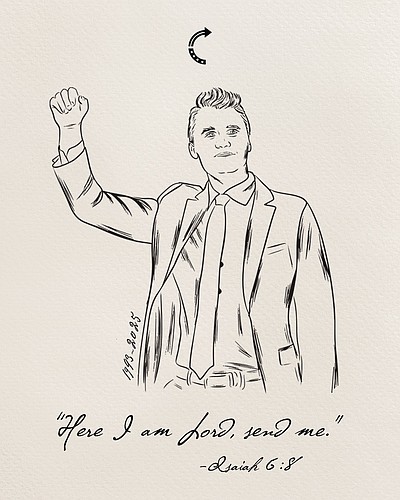 Courtesy of TPUSA
Editor’s note: This My View is a version of the script for the Sept. 12 episode of Between Faith & Reason in response to the assassination of Charlie Kirk.

A man who called a generation to think clearly and live truthfully is gone. Charlie Kirk was a husband, a father, a leader and truly a titan of critical thinking and logical pursuit.
When microphones went live and lights came up, he fought for coherence. When confusion felt easier, he insisted that truth is not a toy you bend to fit your tribe. It’s a reality you submit to even when it costs you. That conviction shaped thousands of young minds and continues to shape hundreds of thousands, if not millions of minds, and has become a movement, one I believe in time we’ll grow exponentially.
But today we grieve. We grieve his loss. The Bible tells us that evil is real, and Scripture doesn’t hide from that. The prophet Isaiah said, “Woe to those who call evil good and good evil.”
Our generation has become fluent in the art of rebranding darkness. We baptize rage as righteousness. Slap virtue words on vice and mistake viral for true.
The Bible says a contest is raging but not the one your timeline tries to sell you. The apostle Paul said, “We wrestle not against flesh and blood, but against the spiritual forces of evil.”
That means our neighbors are not our enemy. Sin is the enemy. Darkness is the enemy. Evil is the enemy. Despair is the enemy.
Yet, lean into this. John 1:5 says, “The light shines in the darkness, and the darkness has not overcome it.”
This is a moment to name the darkness without bowing to it, to name with moral clarity: This was wickedness. But we must not let the wickedness set the agenda for our souls.
In Romans 12, the Apostle Paul reminds us, “Do not be overcome by evil, but overcome evil with good.”
So why does this hurt so deeply? Because every human life bears the image of God. Because death seems to be an enemy. Because in an age of slogans, Charlie lifted the bar for ideas. He didn’t just tell students what to think. He dared them to learn how to think, to follow the evidence, to test assumptions, to love reality more than reputation.
And folks, that call didn’t die with him. It now lands squarely on us.
Let’s discuss causes for a moment. Not the forensic ones but the formational ones. We’ve cultivated a culture that no longer recognizes evil. Not because we lack vocabulary but because we lack a reference point. When truth is reduced to preference, morality becomes a matter of mood. When God is sidelined, the compass just spins.
Proverbs 9 reminds us of this: “The fear of the Lord is the beginning of wisdom,” and that has been traded for the fear of being on the wrong side of a trending narrative. And once you lose the fear of the Lord, you’ll fear everything else. Your peers, your platform, your paycheck.
That fear drives us to pretend, perform and eventually to justify what we know to be wrong. Inherently wrong. And here’s the apologetic heart of it. The fact that we call some acts evil is not a mere outburst of feeling. It’s a truth statement. Objective evil implies objective good.
Good implies a moral law. A moral law implies a lawgiver. Our outrage is a signpost to God. The ache you feel right now is not an accident of simple chemistry. It’s the echo of eternity in the human conscience.
But Christian hope is not just an argument; it’s an event. At the cross, humanity did its worst, and in the resurrection, God unveiled his best.
Jesus did not say we would be spared from trouble. In fact, he said quite the opposite.
In John 16:33, Jesus said, “In the world you will have tribulations, but take heart, I’ve overcome the world.”
Now, that’s not a sentimental notion. That’s resurrection, realism. Evil is parasitic but not ultimate. It can vandalize a moment, but it cannot write the final chapter. Christ already has.
So what now? What does faithful, non-anxious courage look like in a moment like this? I believe it starts with the church, and she must move from events to formation. We cannot entertain our way out of a crisis of meaning. So church, preach the whole council of God, Christ, crucified and risen, the gravity of sin, the beauty of holiness. The call to love even our enemies. Engage minds and imaginations, teach people how to recognize untruth and how to test those claims. And how to speak truth with grace. Model civil courage, being firm in conviction, gentle in tone, quick to repent, eager to reconcile.
We don’t need a louder outrage. We need a deeper holiness!
Christian schools: This is your hour. You exist to help students love God with heart, soul, mind and strength. Build classrooms around truth, goodness and beauty, not as decorations, but as attributes of a personal God. Form intellectual virtues. Humility to learn, courage to stand, charity to listen, perseverance to keep on going, and teach digital wisdom, restraint, accuracy, and charity online so that devices don’t disciple souls more than the gospel does.
Parents, pastors, teachers: This is not a spectator moment. We must become the kind of people who can recognize evil, resist it without becoming it, and replace it with what is true and good and beautiful.
Micah 6:8, one of my favorite verses, says, “He has told you, oh man, what is good: to do justice, to love mercy and to walk humbly with your God.”
You see justice without mercy becomes cruelty. Mercy without justice becomes compromise. Humility without either becomes apathy. But grace and truth together look more like Jesus.
To the next generation, the students who listened to Charlie and felt something awaken inside them: Your assignment is clear. Take up the cause of truth with courage, tempered by grace. Refuse the cheap dopamine of contempt. Don’t measure your impact by decibels. Measure it by faithfulness. Become the same person online as you are offline, and do your research. Read the primary sources, not just what you see on TikTok. Ask honest questions, learn logic and critical thinking. Love evidence. And remember this, clarity is not cruelty, and kindness is not compromise.
So, what can I actually do today? Start small, start near and start now. Speak to others, especially those with whom you disagree, as image bearers, not just avatars.
Edit your words until they’re true, necessary and gracious.
And follow what the Apostle Paul says in Ephesians 4:29, “Let no corrupting talk come out of your mouth, but only such as good for building up.”
Be kind. Mentor one student. Encourage a discouraged teacher. Write one note of thanks to a pastor who told you the truth, even when it was hard to hear. And then stand when it counts. Be watchful. Stand firm, be strong and let all you do be done in love.
To the weary and to the numb: Grief can make us either hard-hearted or holy. Let it make you holy. Lament honestly. Don’t rush past the ache, but don’t live there either. Lift up your eyes. The same Jesus who wept at a tomb walked out of his own! He’s not wringing his hands. He is Lord. And His church? Well, for 2,000 years, the church has buried her martyrs and then kept on building hospitals, schools, charities, families, and communities that outlast empires. And you know what? We will do it again and again. And again and again until Jesus returns or he takes us home.
C. S. Lewis once said: “I believe in Christianity as I believe that the sun has risen: not only because I see it, but because by it I see everything else.”
So let that be our resolve. Christianity isn’t our hobby. It is the light by which we see reality. And by that light, we will live. We will tell the truth. We will love our neighbors. We will form minds and hearts. We will be ambassadors of reconciliation, not arsonists of division. We will honor Charlie’s legacy, not by shouting louder but by living truer.
Just know: This is not a moment for shrinking back. It’s a moment for sturdy hope and holy resolve. Let’s answer this hour with lives that can’t be explained without Jesus. And remember, courage isn’t about volume; it’s about presence. Take the next faithful step and keep going, because the world is aching for people who shine … not shout.
Jesus told us: “You are the light of the world. Let your light shine before others so that they may see your good works and give glory to the Father.”
Turn down the outrage. Turn up the obedience. Build the things evil cannot. Like marriages that last, classrooms of wisdom, churches of grace and truth, friendships that forgive, work that serves, and words that heal.
And when cynicism whispers that hope is naive, answer it with the deeper truth. Our hope isn’t fragile. It’s fueled. We do not carry the light. The light carries us.
Step into this next day, this next week, this next month, like messengers of another kingdom. Shine by telling the truth with a steady voice, by loving the person in front of you, by building what lasts longer than headlines.
Charlie Kirk called a generation to think clearly and live truthfully. Let’s honor that calling by doing what he asked. By becoming men and women whose minds are anchored, whose hearts are alive, and whose hands are busy with good, the good of the gospel of Jesus Christ.
We will not curse the dark, we’ll light more lamps. We will not be ruled by fear. We will walk by faith. We will not merely admire the good. We will become the good centered on Jesus, empowered through His spirit, and we will be that again and again until the city looks a little bit more like the kingdom of God.
Jeff Lawrence is the host of Between Faith & Reason, a podcast produced by Foundation Academy. The podcast is available on all platforms and here.