- March 16, 2026

-
-
Loading
Loading
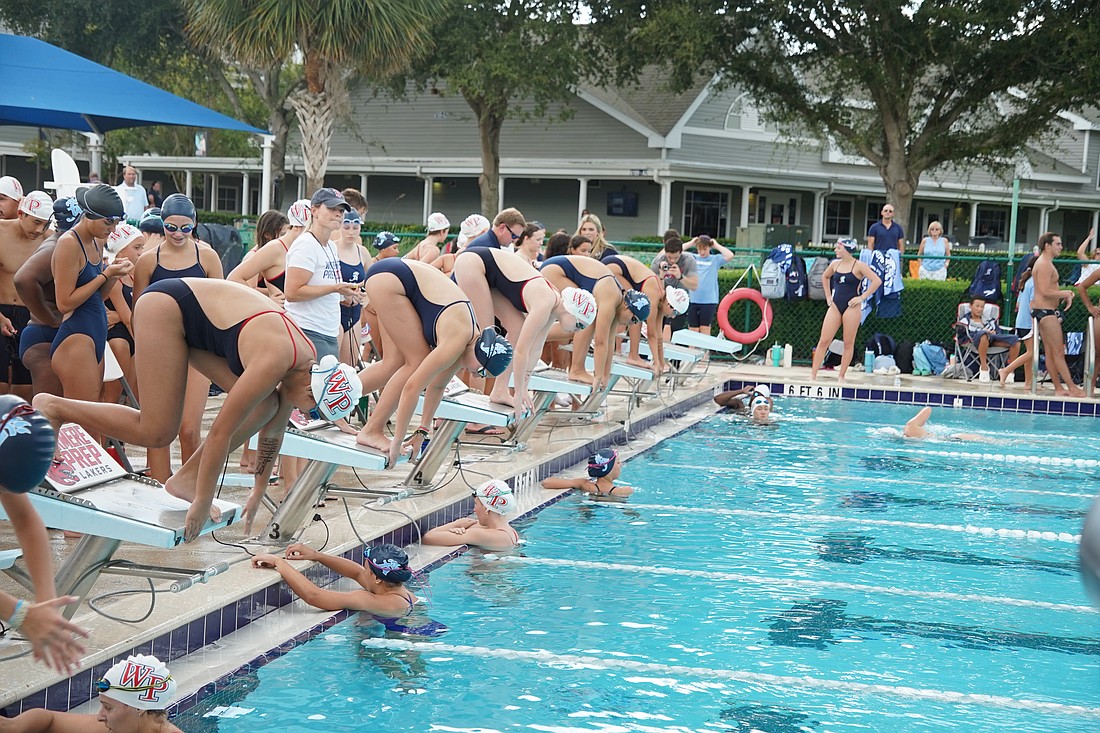
Swimming is a technical sport.
Athletes must take each stroke with precision and accuracy as they dart their way through the water. The winner of a meet can be determined by a matter of milliseconds.
But, it’s not just the athletes who need to be precise; it’s the coaches, too.
High school swim coaches only can take the four fastest to each event in districts; Google Sheets are a coach’s friend.
At Windermere Preparatory School, swim head coach Larry Jukes and assistant coach, Anne Pegues, have a method figured out for the madness. Jukes is in his third season as head coach. The Lakers have sent swimmers to states the past two years, and they intend to do so again.
He came to Windermere Prep with more than a decade of professional coaching on his resume and has taken that knowledge to produce success for the Lakers. But, it wasn’t the path he envisioned 20 years ago.
ROAD BACK TO THE WATER
Jukes calls himself a lifelong swimmer. He earned a top 16 ranking in the 100-yard freestyle at 14 and went on to swim in college at the University of Evansville. There, he was named team captain and pursued his law degree.
He continued to study law and became an attorney, but medical complications threatened his future. In 2000, Jukes started to have seizures for six years and went into surgery to correct the issue. Now he’s seizure-free.
That moment changed his life.
“I had to basically (have) a career redo at the time, and while I was in my hometown, they were looking for a coach in Illinois,” Jukes said. “So I, for 10 years, became a head coach in Centralia, Illinois, and that was my first reintroduction to swimming.”
With the CRCY Barracudas Swim Team in Illinois, Jukes rekindled his love for swimming and found a love for coaching.
“Once I started doing it and actually learning to be better at it, I found out that, ‘I’m actually kind of good at this,’” Jukes said. “Then from there, it just grew and grew. I always had a love for the sport, competing in it, but my love for coaching grew. … I feel like this is what I’m supposed to do. I’m very happy doing it.”
His talent for coaching grew, as well. Jukes had led swimmers to many events, including the USA Senior National, USA Junior National and even overseas to the 2012 World Swimming Championships in Istanbul, Turkey.
The club team in Illinois introduced Jukes to swim camps and Nick Baker, a Canadian Olympic coach who took a swimmer to the Olympics in 1992 in Barcelona. Later, he took his talents to the United States and ran camps in Fort Lauderdale, which is where Jukes met Baker.
“His philosophies on swimming and his attention to detail and all of that — I just latched onto,” Jukes said. “I use many of those things as my philosophies now, too.”
Jukes has coached camps all over the U.S. and the world, traveling to China, Vietnam and Canada. He’s now been coaching for 18 years.
“Coaching camps is where my attention to detail (grew) and attention to the stroke and how to correct strokes, how to teach the stroke,” Jukes said.
Baker wrote a book called “The Swimming Triangle: A Holistic Approach to Competitive Swimming.” The book described swimming as having three sides: physical, technical and mental.
The physical encompasses all the practices, both in the water and on dry land, and strength. Technical focuses on how a swimmer does the strokes, how they start and turn. The third side, which Jukes believes is the most important, is mental.
“That focus on what happens when you get behind the blocks and you start freaking out because the race is here and all those negative thoughts come in your mind,” he said. “(You need to learn) how to combat that and train the mind.”
TACKLING TRAINING
Jukes characterized swimming as the “best combination” of an individual and team sport. Each swimmer is the only one in his or her lane, aside from relays.
“It’s you against your lane, your water,” he said.
The spotlight is entirely on the swimmer representing the school. Each athlete wants to do well for themselves, to earn a spot in districts or states, but they also wants to do well for the school.
“It comes with a lot of pressure that you have to be able to manage and say, ‘OK, I’ve trained all these hours and I’m ready to go,’” Jukes said. “Everything else is out of your mind and let’s swim.”
Combating the mental side during meets all starts during practice.
“When they get to practice, they want to just not think,” he said. “They want to just (listen) to instructions, but let the music play in their head while swimming.”
Jukes and Pegues teach Windermere Prep’s swimmers to think during practice and focus on the “how.” How are they putting their arm in the water? How are they kicking? How are they diving in? Following this allows the swimmers to not think during meets.
“Race with an empty mind,” he said.
Before meets and during practices, the Lakers practice visualization and relaxation techniques to help calm those nerves. The coaches have them hook their feet on the lane lines and float to clear their mind, close their eyes and relieve all of the stress from the week or school day.
They make sure to prioritize the physical training, too.
Four days per week, Windermere Prep practices from 5:30 to 7 a.m., which is primarily the high school level swimmers who are competing at higher levels. Monday, Tuesday and Thursday afternoons, they spend an hour focusing on the developmental aspects of their strokes.
They also do dry land training with a conditioning coach for 30 minutes on Tuesdays and Thursdays. Saturday they have an all team practices.
It’s a rigorous schedule, but that’s exactly what is needed for competition.
GO TIME
To swim in states, a school swimmer must compete in five meets. This is where the calculation from coaches comes into play.
The coaches try to take the four fastest in each event to districts, but each swimmer they bring can compete in only four events.
“Someone may be fast in four events, but they can only swim in two individual events and two relays,” Jukes said. “So even if they’re fast in four events, I have to put them in two, and that opens up different possibilities on where you might want somebody opposed to another person.”
Jukes and Pegues often stay up late going over their possible combinations with swimmers, who to enter in races, who should go in relays. Pegues organized a Google sheet to list the swimmers rankings within the team. They lay out events and check mark boxes to place swimmers in different events.
Once they make it to a meet, the time flies by.
“It’s exciting to see the races happen — especially if you have a close race or a close relay race and they’re battling,” Jukes said.
Last year Windermere Prep placed fourth in districts for women and men, at regionals women came in seventh and men sixth. In states, women came in 20th, men 13th and Addison Bitel, who has committed to Duke, finished runner-up in the 100-meter breaststroke.
This year, Jukes already is planning to send one male and one female to states and assumes he will send relay teams, too.
And although it is quite the accomplishment to make it to states, that’s not an expectation Jukes has set for the team.
“We want to make sure we’re developing the team to compete, to get there as a team and to take as many as we possibly can,” he said. “If there’s a year we take one person, OK, that’s great. And if there’s a year we don’t take anyone, well OK, that’s fine too.”
Windermere Prep’s main focus is centered around the team and building a fun environment for its swimmers. Jukes said is fortunate to have talented swimmers who have consistently made it to the highest level of competition, but he wants everyone on the team to be a priority.