- March 3, 2026

-
-
Loading
Loading
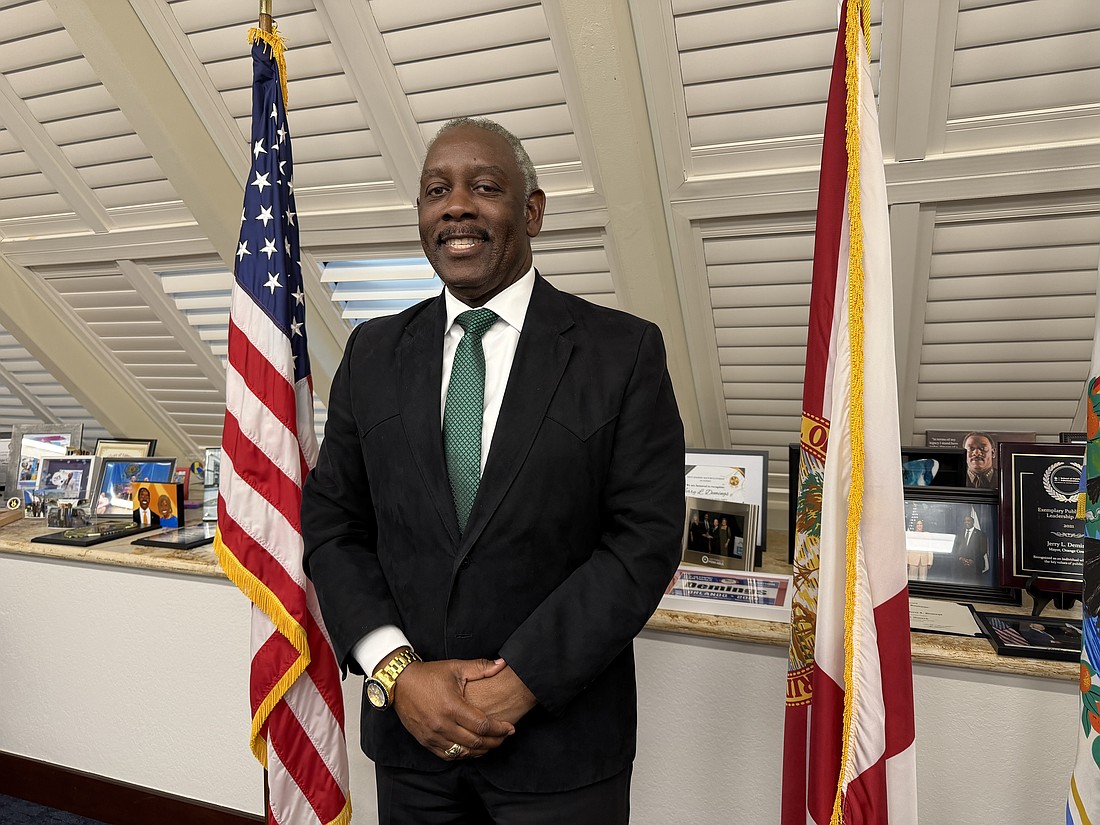
When God closes a door, He opens a window.
Almost every opportunity Jerry Demings has had in his life has been one he didn’t expect but he believes God guided him toward.
He never saw himself pursuing a career in law enforcement as he attended college to obtain a finance degree.
He never saw himself becoming the first black police chief for the Orlando Police Department, the first black sheriff for the Orange County Sheriff’s Office or the first black mayor for Orange County.
He simply wanted to serve others.
And now, that call to service has led him to pursue Florida’s top post.
Demings has disagreed with Gov. Ron DeSantis’ administration and is building his candidacy around the idea of collaboration — something he said is missing from Tallahassee.
“I’ve chosen to get into the arena because I believe that what we have done here can be done on a statewide basis,” he said. “Rather than just sitting and being frustrated about it, I’ve chosen to run for governor, and I believe that by creating a grassroots movement, I can be elected governor. I’m not afraid to at least try to do it, to convince other people that I’m the right person at the right time.”
The call to serve has been drilled in him since his humble beginnings growing up in Washington Shores, which as he describes, is a “proud and close-knit mostly black community on the west side of Orlando,” a neighborhood where everyone knows everyone, looked out for one another and believed in hard work and faith.
He grew up on the same streets as Orange County trailblazers, including Commissioner Arthur “Pappy” Kennedy, the first Black Orlando City Council member; Louis Crooms, one of the first Black deputy sheriffs; and Mable Butler, the first Black female Orlando city commissioner and the first black female Orange County commissioner. All served as role models to Demings.
“Growing up in their shadow and their neighborhood was a powerful reminder that greatness could rise from right where we lived,” Demings wrote in his book, “Believe: Faith, Truth and the Courage to Lead.”
Throughout his life, he looked up to these role models for guidance with hopes he was serving as a role model himself for younger generations. He has implemented strategies, programs and initiatives as a law enforcement officer and political figure with hopes of making Orange County better for its citizens.
“There’s a reason I am where I am today,” Demings wrote. “It’s not necessarily because of talent or titles. It’s not because of politics or public platforms. It’s because I had a mother who taught me to believe in myself. And it’s that belief that gave me the courage to pursue my passion for public service.”
The driving force behind all Demings does is his unwavering belief in God, a belief inspired by his mother, who ensured he and his siblings attended church consistently.
Throughout his career in law enforcement and serving as a public official, Demings wrote in his book he was focused on “climbing the ranks, securing promotions and building a legacy in public service.”
But he came to a realization his life has been shaped by the doors God has opened for him that Demings never considered before. He didn’t always understand why he was pushed in a given direction.
“But now, I see it clearly: it was never about a badge or a ballot,” Demings wrote. “It was about purpose.”
His purpose to serve others and serve God has inspired him to continue to serve his family and community, despite any challenges, in his various capacities as an officer, police chief, sheriff and mayor.
“It’s about what God wants to do through you,” he wrote.
Demings never thought his career would take him into law enforcement. He graduated from Florida State University with a degree in finance and went on to earn a master’s degree in business administration.
He started his professional career as an accountant when he moved back to Orlando and started his first job.
But he never forgot about his interest in law enforcement that piqued when he met recruiters from various federal, state and private sector agencies during a job fair at FSU. The Federal Bureau of Investigation was looking for individuals with backgrounds in finance and accounting to do white collar criminal investigations, which interested Demings.
Not only were the recruiters looking for someone with Demings’ abilities but also Demings had personal reasons for his motivation to enter a career in law enforcement.
Demings’ brother, Joseph, who was 10 years older than him, died at 50 years old after years of drug addiction.
There came a time when Demings himself had to arrest his brother for drug possession. Knowing and seeing his brother’s struggles firsthand motivated him to work to eradicate drugs in Washington Shores, the neighborhood in which he grew up in the post Vietnam War era.
“In my neighborhood, drugs were kind of rampant,” Demings said. “A lot of my classmates found themselves either addicted or selling drugs, and it destroyed the neighborhood, the moral fiber of our neighborhood.”
When Demings returns to his childhood home, which he and his twin brother, Terry, still own in Washington Shores, he bumps into former classmates, many of whom have struggled with addiction.
“Many of (my classmates) are dead because of drug addiction,” he said. “The rapid spread of drugs in our community destroyed individuals and their viability to be able to take care of their families.”
The FBI went into a hiring freeze, but recruiters encouraged Demings to obtain some local law enforcement experience.
“I didn’t know if I really wanted to do that job or not,” Demings said. “I had a wonderful job as a young 21-year-old working as an accountant. I had a traveling job. I had an executive assistant, I had an expense account. It was a great job, but it was a lonesome job.”
Having two twin sons at home, Demings hated to constantly have to say goodbye to them as he traveled for work. He said his sons would look at him questioning who he was because he spent so much time away.
Knowing the impact drugs can have on a family, wanting to spend more time with his own family, never forgetting his interest in law enforcement and knowing he could have a job in the community in which he grew up sparked a career move.
After spending a year as an accountant in Orlando upon graduating from FSU, Demings shifted gears and became a police officer for the Orlando Police Department in 1981.
Little did he know, his career in law enforcement would lead to history-making moves.
Demings quickly moved up the ranks of the Orlando Police Department.
Despite being unsure of whether he truly wanted a life as an officer, he came to realize he enjoyed the position. He didn’t expect to spend 21 years in the department, going from a street cop all the way to being appointed the 34th Orlando chief of police in 1998 and becoming the first Black police chief in the department’s history.
Throughout his years of service both with the Orlando Police Department and later with the Orange County Sheriff’s Office, where he served as the first Black sheriff, Demings saw his role as an opportunity and a challenge as it required him to see friends and loved ones caught up in the “degradation of what drugs mean to a community.”
“I had, at one point, to arrest my own brother, I arrested some of my friends in some ways to rescue them from themselves, because every addict will tell you they could stop,” Demings said. “But the reality is, very few of them had what it takes to stop themselves from destroying their health, destroying their families and getting arrested. It was a terrible social experiment for people to think they could use drugs and it wouldn’t be them that would get addicted.”
Playing a role in reducing the prevalence of illegal drugs in the community became a calling and a passion for Demings.
He went on to volunteer with the Mental Health Association of Central Florida and work with other drug treatment programs such as Aspire Health Centers’ Marchman and Detox facility, formerly known as the Center for Drug-Free Living.
He also served as a scout leader and served on the council for the Central Florida Boy Scouts of America. He coached Little League Baseball with the Police Athletic League and coached the Junior Magic League.
He served on boards of directors for the Central Florida YMCA, the Boys and Girls Club and other youth-related organizations.
His hope was investing in youth programs would encourage young people to steer away from a life with drugs. He thought surrounding them with appropriate role models and inspiring them to pursue their dreams could influence the trajectory of the youth.
Demings urged for more intervention strategies to help people, especially those struggling with addiction, to obtain counseling or treatment and for there to be quality housing and job skills development programs. He also pushed for enforcement strategies, and if needed, prosecution to ensure people are held accountable for their actions.
In 2002, as the deputy county administrator and director of public safety for Orange County, Demings reconvened the Jail Oversight Commission, which developed goals that were implemented as a county-wide strategy that included having a central receiving center where individuals who commit minor law violations, were mentally ill or suffered from substance abuse or behavior disorders could receive treatment. Rather than sending them to jail, they received treatment. He said it reduced recidivism and helps them to become functional members of society.
Now as Orange County mayor, Demings said he has been able to use his four-and-one-half decades in law enforcement to see the full picture. He was elected in 2018, marking another moment in history as the county’s first Black mayor.
“The compassionate side of me says we can do better as a society,” he said. “So as a mayor, take it full circle. The sum total of my experiences made me very unique in being able to now set policy.”
As mayor, he has worked with the Orange County Board of County Commissioners to change policies over time through collaborations with public and private partnerships and philanthropic partnerships, many of which invest in the community’s youth to provide resources for prevention and intervention.
“My style of leadership is one to engage across the disciplines where it’s a community,” he said. “These are community problems. It’s not a law enforcement problem. It’s not a government problem. It’s a community problem that needs the collaboration of the community. I’m privileged to have been on the ground, worked thought it, lived through it, having the life experience to kind of know what works, how to look it for the bigger, broader picture of what we’re trying to do.”
Demings wrote he had moments where he wanted to walk away as well as moments he questioned whether he was the one to do whatever job.
“However, every time I tried to retreat, God reminded me that this is bigger than me,” he wrote. “It’s bigger than politics, bigger than speeches and bigger than appearances. It’s about purpose. Having a sense of purpose helps to ground you when life’s challenges arise.”
Demings is taking his call to serve to the next level: running for governor.
He said he’s unhappy with the current trajectory of the state as the current administration in Tallahassee has “done very little to really work with local governments.”
“Instead, they have driven a wedge between local government and the state, but we’re a subdivision of the state,” he said. “We all will benefit if the federal government, the state and the local governments work closer together. I’ve been around long enough, I’ve seen that model work.”
He said one group has “absolute control” and is “ignoring the majority of the people’s opinions and what really works.”
At 66 years old, Demings said he has made enough money he could retire and not worry about working again. But he is choosing to continue his public service.
“I feel like I’d be giving up on Florida,” he said. “I’m not ready to give up, so I’m choosing to stay in the fight, try to make it different, try to make it better for all of us, for my children, my grandchildren.”
Demings said he initially wanted to stay out of the political race for governor. He simply wasn’t interested, but he had too many frustrated people come to him saying he was the individual they trusted to run.
“I’m a bridge builder, I’m a crisis manager; that kind of distinguishes me from any other candidate,” he said. “So far, in the race of nearly 30 people, there’s not one that’s going to have that on-the-ground crisis management experience because of my role, having been a police chief or sheriff or public safety director and now mayor, wrestling with the problems that’s most important to average people, not the billionaires, but average people, working at the granular level.”
As a man of faith, the prayer of Jabez has guided him in life: “Oh, that You would bless me indeed, and enlarge my territory, that Your hand would be with me and that You would keep me from evil, that I may not cause pain.”
At times when he feels most in conflict — he is wrestling with decisions, being pulled in different directions, frustrated or distracted, anything to deter him from his purpose to serve — Demings reminds himself of the prayer of Jabez.
“Every one of these opportunities that I have been used to bring about a change, someone saw me in that position before I saw myself,” he said. “I got increasingly more and more responsibility, more demand to lead. It’s easy to lead when everything is going right. It’s very difficult to lead when things are going terribly wrong. Florida needs someone that’s a good crisis manager, a unifier, a bridge builder, that’s competent, that’s caring, that is collaborative. They need that kind of leader. I’m offering myself up as that kind of leader, and we’ll see.”