- March 4, 2026

-
-
Loading
Loading
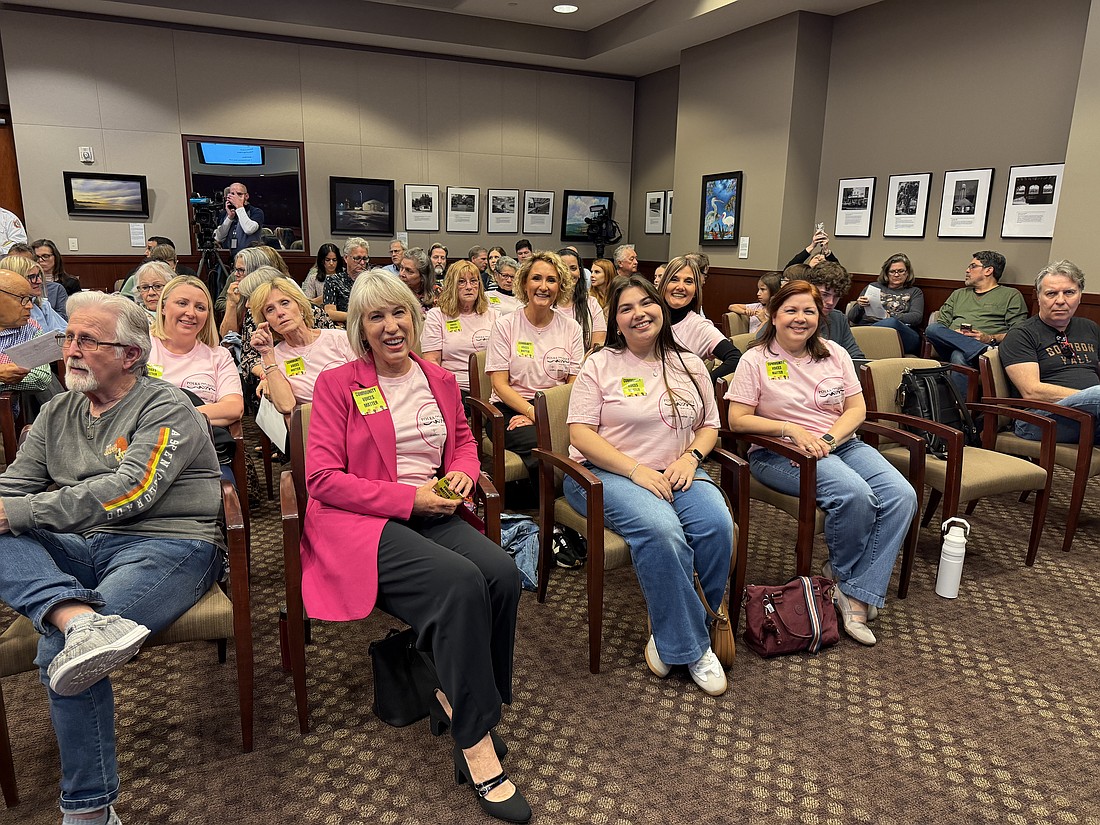
With one individual purchasing numerous buildings around downtown Winter Garden, residents went to the Winter Garden City Commission meeting Thursday, Feb. 26, to express their concerns.
James Larweth has spent more than $40 million since 2015 buying 36 residential and commercial properties in downtown Winter Garden using 26 different LLCs. Residents fear what Larweth is planning as two small businesses — Polka Dotz and Three Birds Café — at one of his properties already have been told they will not be given the option to renew their leases.
Three Birds Café closed its doors at 2 W. Plant St. Thursday, Feb. 26, while Polka Dotz, located at 12 W. Plant St., has until June to find a new home.
About 150 residents packed the commission chambers and listened as Kelly Carson, the city’s planning director, gave a presentation on what city staff can and cannot do, noting that city staff shares the public’s concerns.
“Nobody here at City Hall wants to see downtown Winter Garden lose its charm that it’s known for,” Carson said.
The city cannot interfere with private real-estate transactions, Carson said, just like anyone selling their home doesn’t have to come to the city to have a new buyer approved. Winter Garden also cannot approve or deny private lease agreements or pass regulations that explicitly ban chain stores and/or franchises in the city, she said.
Winter Garden Deputy City Attorney Daniel Langley said if the city were to do any of this, or establish an ordinance that bars certain buyers from purchasing property downtown, the city likely would run into constitutional problems at the state and federal levels.
“The government cannot interfere with the right of the property owner to transfer the title to another person,” Langley said.
What the city can do, though, Carson said, is employ strict architectural ordinances, such as detailing and signage, that deter the larger corporations from setting up shop downtown. The city also can determine zoning, allowing restaurants to open downtown but not, for example, a car dealership.
“We can’t say, ‘There can never be a McDonald’s downtown.’ But what we can say is, ‘The building needs to look this way, and oh, that sign won’t work, because we have specific signage standards, and oh, you can’t put a drive-thru downtown,’” Carson said. “So (chain stores) will say, ‘It doesn’t work for us.’”
Carson said many of these regulations already are in place downtown and in surrounding areas to help protect its charm and character, adding they might even be stricter than those found in Winter Park and other cities. For instance, the city has a historic district overlay code that applies to all properties in the historic downtown and an Architectural Review & Historic Preservation Board, made up of residents in the area, that determines what can be modified.
“The bottom line is that Winter Garden, we believe, is well-positioned under federal and state law to protect small, independently owned businesses versus those national corporate chain stores,” Carson said. “We think the tools we have in place are effective and enforceable, and we will continue to evaluate our toolkit we can use to regulate these sorts of things, to make sure we are in the best position possible to preserve our small town charm.”
Economic Development Director Marc Hutchinson provided an update on the city’s efforts to secure new locations for Three Birds Café and Polka Dotz. Hutchinson said on six occasions, staff has reached out and explored options with the business owners, not including phone calls.
Hutchinson said there was “active interest” to relocate by one business owner, but the interest “later waned and diminished” when efforts for the right spot were unsuccessful. The other business owner, Hutchinson said, offered a conditional interest to only relocate on or along Plant Street and not on an adjacent side street, with the concern being that side streets would harm the business’ success.
Although residents said the presentation provided clarity, they still had concerns.
Cheri Janetzke, a Winter Garden resident for the past 25 years, said she loved the city so much she bought a second home closer to downtown about six years ago.
Janetzke applauded the work the commission has done helping grow downtown in that time but also feels the commission can do more to get answers.
“I do feel that this commission has political leverage, incentives and strong marketing you can use to help Larweth see and guide him to maintain the current downtown Winter Garden,” she said.
Taylor Boyer and her husband moved to Winter Garden about a year ago after living on the east side of Orlando for 20 years. She said she dreamed of a day when she moved to Winter Garden to start a family, but recently, when she drives around and sees duplex after duplex, she’s noticing a pattern.
“When one individual accumulates this much property, rezoning requests are rarely far behind,” Boyer said. “I urge our mayor and our commissioners to stand firm when, not if, those requests come forward. Zoning decisions shape the character of our downtown for generations, they should reflect the will and well-being of the people who live here — not the ambitions of someone who has yet to demonstrate any real investment in our community beyond real-estate holdings.”
Katie Bush said she noticed houses around her have been sold and renovated, only to sit vacant for extended periods. Bush suggested a vacant property registration program that would increase fees the longer a home is left unoccupied, incentivizing productive use of high-demand properties around downtown.
Among the packed crowd of residents was Heidi Hardman, owner of Polka Dotz, who was not given the option to renew the lease for her business in the Bond Building on Plant Street. She had a front-row seat with eight women, all of whom wore pink shirts with “Community Voices Matter” printed on the back. The group also handed out lime green stickers with the same slogan.
Hardman told commissioners she has had a successful small business in Winter Garden for 19 years, and she has been a resident for 16 years.
“Our business has not been built on transactions; it’s been built on relationships,” She said. “So, when I got my termination letter for my lease, it was exactly that; it was a transaction. I’m not saying it was illegal; it wasn’t. But it had no reference, no vision shared, no acknowledgement of what we built.
“I came here again for the vision of this community, not to support the legacy of small business annihilation, resident disrespect and the destruction of our community,” she said.
Hardman said she was taking a risk speaking at the meeting because local small business owners had been threatened with legal action, having been told to “tone down the temperature” when they try to speak up.
“The truth is, we understand growth,” Hardman said. “... That’s just part of business, that’s part of community, that’s part of growing. But growth without transparency and without respect just does not feel like progress.”