- March 25, 2026

-
-
Loading
Loading
When Nick Kosteski enters the gym to coach the boys’ competitive teams at Gymnastics USA in Winter Garden, he makes his way across a sea of mats and equipment. He is first flagged down, though, by nearby 5- and 6-year-old gymnasts who stop what they’re doing for just one thing: to shake his hand.
It’s one of the first lessons the boys are taught at the gym, Kosteski said, making sure they know how to stand up straight, provide a firm handshake and show respect before they ever learn about gymnastics.
“Just from the beginning, we really teach the values of hard work first,” he said. “We do the same things as every other club. We do the same push-ups, the same sit-ups, the same pull-ups. But we really try to instill at a really young age how important it is to, when you’re doing it, to actually do it right. And that’s really hard to teach a 5-year-old.”
Gymnastics USA trains teams from level 3, a beginner stage comprising mostly of 7-year-olds, to level 10, the highest level featuring high schoolers.
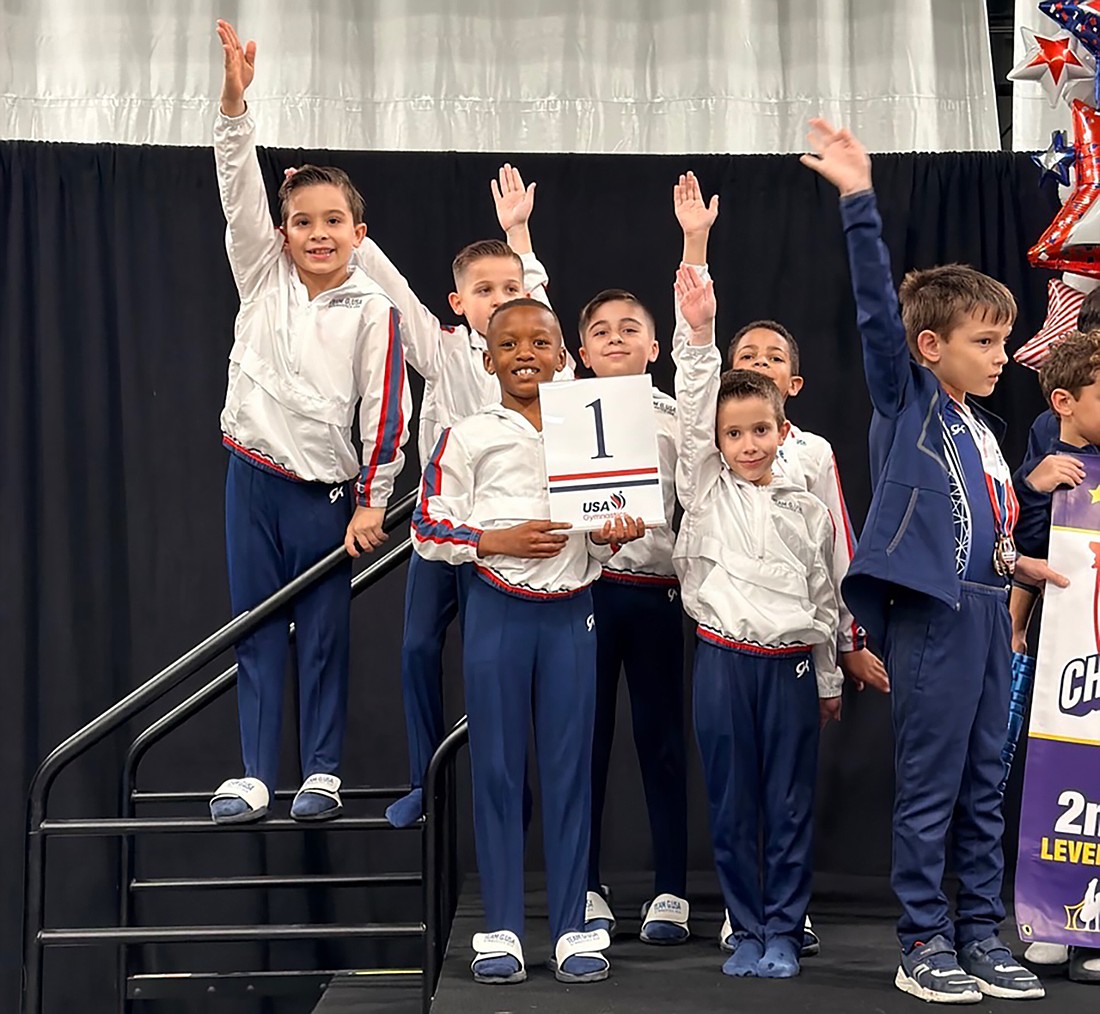
Most recently, the boys competed in the Florida State Championship Friday, March 6, to Sunday, March 8, in Ocala. Out of the gym’s 33 boys of all levels who competed, 31 qualified for the regional championship to be held from Friday, March 27, to Sunday, March 29, in Atlanta. Meanwhile, the level 4 and level 5 teams finished first in the state, and more than 25 boys won individual state titles.
Gym owner Zander Arthur said the 31 boys are the most the club has ever sent to regionals, a culmination of a goal he and Kosteski set out to achieve since he returned to coach in 2020.
Arthur said it’s the first time in Gymnastics USA’s history that they don’t have any bad gymnasts on the team, that they’re all good and on track to either compete at the collegiate or international levels.
Arthur returned as the club’s developmental coach because his son was beginning to learn gymnastics, and he wanted to be there for him. It has since created a strong bond between the two, even during the harder practices. Now, Arthur is tasked with helping the level 3 to level 6 teams. He won the 2025 USA Gymnastics Compulsory Coach of the Year.
Upon joining the program, lower-level competitors like Arthur’s son typically start on the developmental team and train there for about a year. Each time they advance a level, the routines and events become a little more difficult. The youngest athletes train about nine hours per week, while the more experienced ones log up to 20 hours.
The progression is gradual. At level 4, they learn how to complete a front hand spring on the floor; at level 5, they’ll do two front hand springs in a row; and at level 6, they perform a front hand spring to a front foot.
It’s that time commitment and accountability that have produced the recent successes, Arthur said, holding the young gymnasts to high standards.
“Every turn they take, there’s accountability with it,” Arthur said. “Every single turn they take, there’s a benefit or there’s a consequence. The benefit might be they get to move on to something else if they do a good job. The consequence is that they have to do more, or they have to do additional exercises.”
Arthur said that type of training — four hours per day, five days per week for the gymnast’s entire childhood — is what produces elite-level athletes, setting them apart from the 29 other clubs in the state.
During this time, Kosteski said one of the most common mistakes young athletes make is thinking just showing up is good enough to excel.
“Gymnastics is such a hard sport,” Kosteski said. “A lot of kids think they could just come in and go through the workout, go through the motions and think that they can improve just because they’re here for a very long time. But if they’re not focused and if they’re not thinking about the skills they’re doing every time they get on the equipment, then it’s really hard to make improvements.”
Each level competes in all the events — including floor, pommel horse, rings, vault, parallel bars and high bar — practicing most, if not all of them, every day they’re in the gym after warming up, stretching and conditioning.
From levels 3 to 7, competition scoring is capped at 10, meaning if a gymnasts don’t commit a single mistake, they receive a perfect 10, but every error costs them a tenth of a point.
“Every mistake they make, the judge is watching, and then they’ll mark down on their paper, you know, if a kid bends his knees, they’ll mark down one-tenth off, so you’re down to 9.9,” Kosteski said. “There are a lot of different mistakes in gymnastics, and there’s so many different events and different types of mistakes you can make. The judges are pretty good at taking that 10 away from you pretty fast.”
When the gymnasts are young, Kosteski said, it’s all about who is the cleanest, whose legs can be the straightest and whose toes can be the most pointed. But for the older levels, from 8 to 10, scoring isn’t capped, so there is more room to earn points for completing higher-level skills, but the judgment can be harsher.
During the state championship, Kosteski said the boys’ success came from limiting mistakes and not failing skills they normally practice.
“They work really, really hard every day,” he said. “It’s not about what they did at the competition. It’s about what they do in the 20 hours a week that they’re here. So they were just very focused, especially in the week leading up to the competition, very focused on eliminating those silly mistakes that take you from like a 9.5 to a 9.4.”
Kosteski said many kids get nervous during competitions, which makes them tense. It’s especially clear, he said, when they swing on the pommel horse, the event that requires the gymnast to twist and swing their body around, only using the upper body. The nerves cause the competitor to tighten up and fail.
The boys, though, performed the way they practiced, Kosteski said, and eliminated any “silly mistakes.” He said seeing them then take the stage at the end of the event and receive recognition after so much work and dedication is why he loves coaching gymnastics.
“It’s just very rewarding to see as a coach watching them put hours into a skill, hours into an event, hours into their own gymnastics, and have them be rewarded,” Kosteski said.