
- July 1, 2026

-
-
Loading
Loading
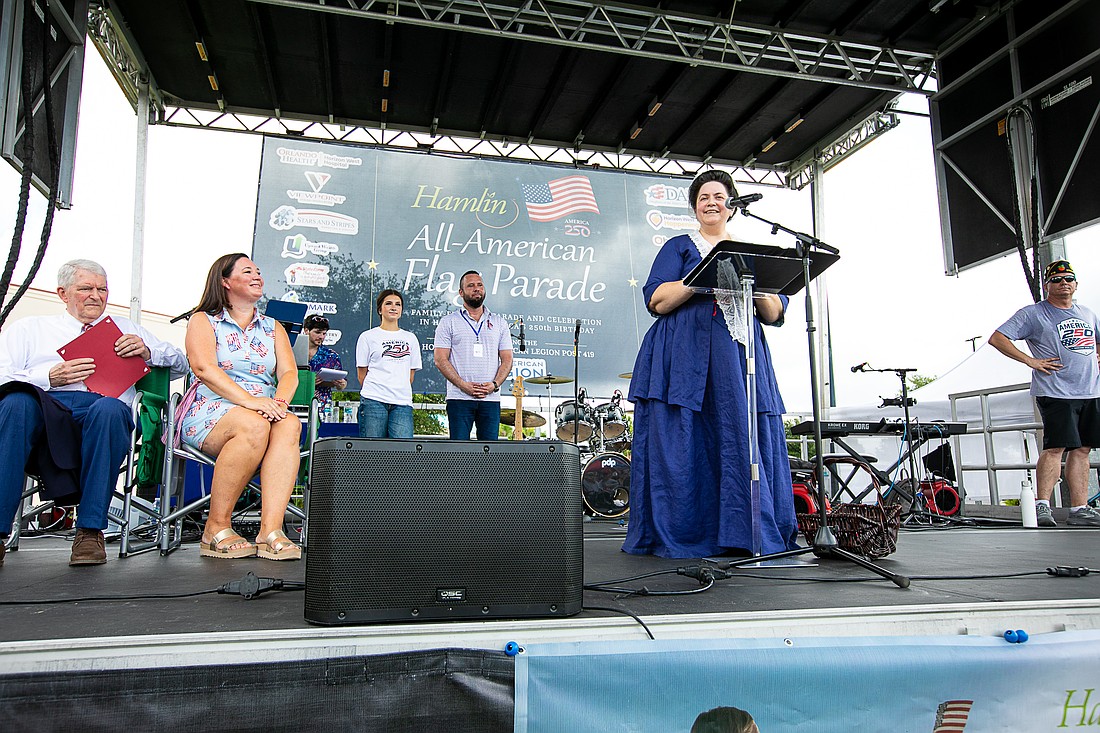
Marcea Oetting has been a historical reenactor for nearly 10 years.
The passion for history began at a young age, as Oetting constantly found herself reading historical figures’ biographies.
She found them fascinating.
“History is not names and dates,” she said. “It’s a giant story, and every piece lays on top of the other. That’s one of the neatest things about it — to see that progression, to see the evolution, to see how one story contributes to another.”
More than that, Oetting’s birthday is July 2, and she always thought the Independence Day fireworks were for her.
“When I was a little kid, my grandma always told me that the fireworks were just for me, and grandmas don’t lie,” she said.
It created a positive correlation between her birthday and America’s independence, when she found herself happy and joyful of the celebrations each year.
She still recalls celebrating America’s bicentennial in 1976, as a 6-year-old, and holds that memory close to her heart.
The love for history never went away, and Oetting even went on to study history in college.
“The women are always fascinating because they’re not necessarily always in the history books, but they’ve been there all the time, writing their stories down, contributing, doing,” she said.
Today, Oetting finds joy in reenacting historical women, telling their stories with accuracy and passion. She portrayed Abigail Adams — her favorite — at Hamlin’s All-American Flag Parade June 20. And this weekend, she will do the same at Ocoee’s Fourth of July and America 250 Celebration, which takes place from 5 to 9 p.m. Saturday, July 4, at Bill Breeze Park, 125 N. Lakeshore Drive, Ocoee.
HISTORICAL CONTEXT
Oetting joined the Daughters of the American Revolution wanting to contribute to its mission: preserving and promoting historic events, education and patriotism.
She joined right in time for a Veterans Day parade and wore an Abigail Adams costume her mother made for her.
People came up to her asking to take photos, questioning who she was. She found joy sharing facts and information about one of the most prominent women in American history.
Something was reawakened in her that day, she said.
She thought of the idea to become a reenactor. She already had the costume, so that’s what she did in 2017.
“Doing it just felt like a natural extension of who I am,” she said.
To be a reenactor isn’t simply putting on a costume, though.
“It’s a lot of research,” Oetting said. “You have to understand the historical context of things and you have to understand the time and what they were up against.
“This is really a service to America,” she said. “We commit to doing this to help educate people about history in America. … Maybe they didn’t do right all the time. They made mistakes, just like we all do. If we can grant grace to the past, maybe we can start granting it in the present.”
MULTIPLE PERSONALITIES
Oetting portrays more than 12 women from different eras, and she does so with care, responsibility and understanding.
Her favorite woman to reenact is Abigail Adams, someone she said always has been one of her favorite people in the world.
Primary sources are Oetting’s go-to to learn about those whose stories she’s telling, and she quickly found herself reading John and Abigail Adams’ letters one after the other.
John and Abigail Adams often exchanged letters as he went away on business trips, but Abigail Adams found herself frustrated with John Adams, Oetting said.
Abigail Adams claimed John Adams was not sending her the amount of letters she anticipated. However, his letters were going astray.
John Adams decided to purchase a blank notebook and copy every letter he wrote to Abigail Adams to show her even if she didn’t get his letters, he was writing them.
He even suggested to Abigail Adams to let their children copy her letters to him down, so they could practice their penmanship. These letters made it easier for Oetting to understand who Abigail Adams was as a person and her family dynamic.
“She’s so quotable,” Oetting said of Abigail Adams. “She has some excellent lines that just really pop out, but research never ends. I’m still finding out new things about Abigail.”
Oetting also finds letters from other women from the same era to better understand the reality of being a woman in that time period.
“Being able to find these documents and find these quotes is just one of the most fun things that I get to do,” Oetting said. “It’s helping people to understand that so often you look at a history book with a flat picture and a name. What I’m trying to do is get it through three dimensions.”
She does that with each woman she portrays.
“I know this is going to sound crazy, but they talk to me,” she said.
She said the most important part of being a historical reenactor is to present these women’s stories from their point of view, and that starts from the skin out.
She digs deep into the fashion, the mannerisms, the historical era and the relationships to portray these women honorably and accurately.
Sometimes, she said, history books aren’t all that accurate. Sometimes, people need to dig deeper to find other truths.
“A lot of times these women were put in situations they didn’t have any control over,” Oetting said.
To her, telling these stories is important because “it’s our story,” she said.
She hopes to be able to continue educating others on the women that silently shaped America’s history, to make sure they are seen and heard.
“I present all the evidence — the good, the bad and the ugly — and let the audience make their own moral judgements,” she said.