- July 1, 2026

-
-
Loading
Loading

Leon presented Oakland Town Commission and residents Tuesday, June 23, with the first budget work session for Fiscal Year 2026-2027.
Leon said in the core of creating the budget was principles, such as maintaining a structurally balanced budget, prioritizing essential services and public safety, preserving financial stability, and ensuring transparency and accountability.
The budget was based on a 6.7 millage rate, which has remained consistent since 2025.
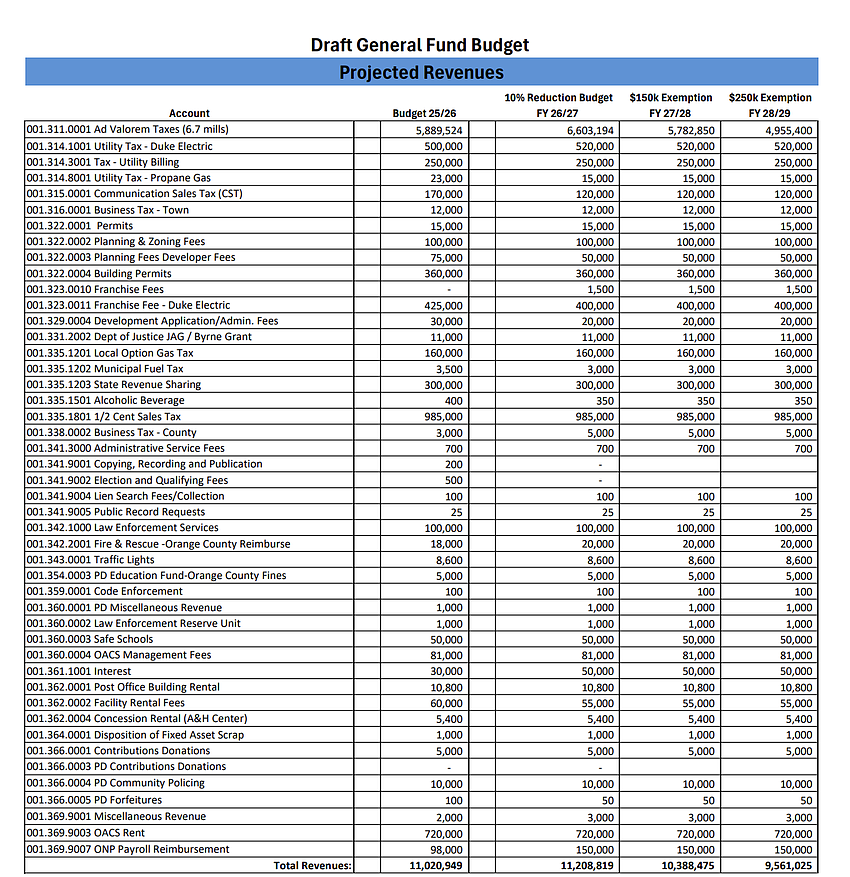
Leon said the largest source of revenue for the town will be ad-valorem taxes, which accounts for about $6.6 million, or 59%, of the town’s total revenue.
The second largest source of revenue comes from sales and use taxes, which accounts for about $2.3 million, or 21%, of the town’s total revenue.
Altogether, the General Fund budget is projected to be $11,208,819.
Leon said property values in the town of Oakland have increased by 12.18% from last fiscal year, increasing the ad-valorem revenue by $713,670.
Because of that, the town’s fire rescue bill also increased by $343,000, now at $2,585,000.
The three largest departments in terms of expenditure are police at $3,066,026, fire at $2,625,000 and general government at $1,492,460.
Total expenses for Fiscal Year 2026-2027 equal $11,084,437 and include $180,000 for road resurfacing, $100,000 for Comprehensive Plan updates, $100,000 for land purchase near the town’s roundabout and also reflects a 10% decrease across all departments per Leon’s request.
The town’s contingency budget for the upcoming fiscal year totals $124,382.
Leon also made projections for Fiscal Year 2027-2028 and Fiscal Year 2028-2029 to allow commissioners and town residents to understand the possible impacts to the town’s budget if property tax amendments pass in November.
If the amendment passes, Leon said, the town could see budget deficits starting in the first year of homestead property exemptions, with a $820,000 decrease in ad-valorem revenue each fiscal year.
However, she said the predictions are not all accurate, as the town could see a decrease or increase in non-ad valorem revenue, such as sales and use taxes, licenses and permits, fines and forfeitures, and others.
For Fiscal Year 2027-2028, Leon estimates a $255,213 deficit in its budget, as expenditures cost more than what the town receives in revenue.
In Fiscal Year 2028-2029, she estimated a $595,467 deficit.
Leon said the deficit comes even after reductions across departments and the removal of a cost-of-living adjustment for government employees.
Leon said the town might need to consider reducing staff benefits such as health care, reducing staffing levels in departments or reduce work hours.
Town Manager Elise Hui said department heads currently are looking at free services the town offers, such as debris pick-up and back-flow prevention tests, to see what can be passed on to residents to offset expenditures in forecasted fiscal years.
Mayor Shane Taylor said he asked Hui to reach out to Orange County Fire Rescue for a cost breakdown of to run the station serving the town.
OCFR told Hui budgets aren’t made per station, and she has not yet received further information she requested.
“I don’t think the model they’re using should be driven by taxable income or taxable property like they’re doing now,” Taylor said. “It should be per unit. I would think the cost to put out a million-dollar home is the same cost to put out a $300,000 home.”
Taylor said the town’s goal is to protect the core services necessary to run the town, while working around the “cards that we’re dealt.”
Briley Farm Phase 1
Town commissioners unanimously approved the first reading of Briley Farm’s Phase 1 planned development and development agreement amendments.
Briley Farm currently is working on Phase 1 of its traditional neighborhood totaling about 36 acres.
The proposed amendment would incorporate 302 Briley Ave., Oakland, into the planned development and development agreement.
On top of that, the developer would like to split that newly acquired lot and split the lot on 415 N. Walker St., Oakland, into three lots. This would increase the allowable single-family residency lots from 53 to 55.
The lots then would be reassigned as Type D lots, which is a standard lot with a rear- or front-load garage. When rear loaded, the garage is accessed via a side drive from the street.
The amendment also would set streetscape guidelines while continuing to follow the town’s ordinance and United States Postal Service rules.
The second reading will take place Tuesday, July 14.