- July 24, 2026

-
-
Loading
Loading
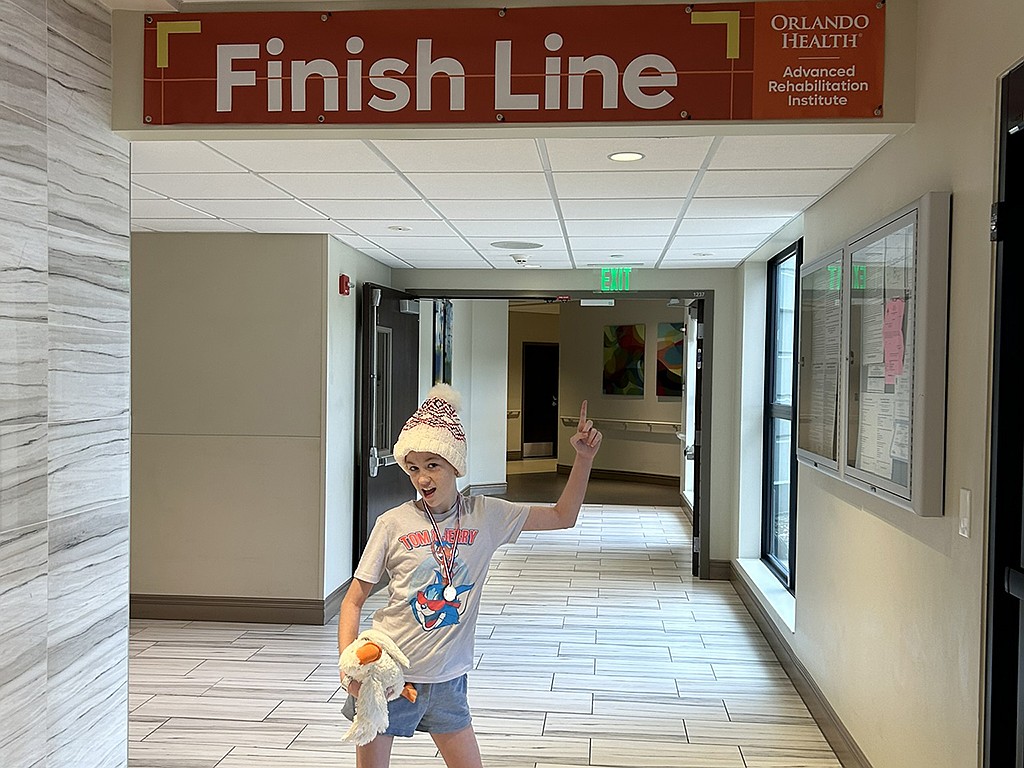
March 23, 2007, has had an extreme significance to Winter Garden’s McMann family.
On that day, veteran Andrew McMann was serving in Iraq when he was hit by an improvised explosive device resulting in him having broken legs and a traumatic brain injury.
For the past 19 years, McMann and his family have thought of the date as a day of injury and disability.
“The body keeps score,” he said.
But that all changed March 23, the day his 12-year-old daughter, Esther McMann, was supposed to go to a doctor’s appointment at 7 a.m.
However, when Esther’s mother, Mary McMann, went to wake her up at 6:20 a.m. for the appointment, she noticed Esther wasn’t feeling well, prompting her to cancel her appointment.
While she was canceling the appointment, Mary McMann explained to the person on the other end of the line what was going on with Esther.
“When I went to wake her up, she would not wake up,” Mary McMann said. “I picked her up, moved her to the couch, and she wouldn’t walk … She wouldn’t open her eyes, and she wouldn’t talk.”
The receptionist suggested Mary McMann take Esther to the pediatrician immediately.
“Even then, I tried to get her dressed, and she wouldn’t,” Mary McMann said. “This is a healthy kid, I was like, ‘There’s something really wrong.’”
‘I can’t believe we didn’t lose her’
Worried for Esther, Mary McMann quickly transported her to the emergency room.
Esther was taken to complete a CT scan, which showed a brain bleed.
“The doctor comes and tells me, ‘I don’t know how to tell you this, but she has a bleed in her brain, and it’s big. … This is either a tumor or an AVM (arteriovenous malformation),’” Mary McMann said.
The ER called an ambulance to transport Esther to Orlando Health Arnold Palmer Hospital for Children, and when she arrived, she was taken into surgery.
Because of the brain bleed, surgeons placed an external ventricular drain in Esther’s head, to drain the bleeding for a few days.
Surgeons also confirmed Esther had an AVM, an abnormal tangle of blood vessels that creates irregular connections between arteries and veins in the brain.
“The arteries and vessels are pumping blood toward each other, so it could rupture again,” Mary McMann said.
Andrew McMann already was suffering from PTSD, and now he was unsure of what was to come for his 12-year-old daughter.
“I asked him how he was doing, and I was very shocked to hear him say, ‘I can’t believe we didn’t lose her,’” Mary McMann recalled. “‘From now on, this is our day of life.’ It used to be our day of injury, disability, but now, this is our day (of life) — he survived and she survived.”
Esther was supposed to get surgery for an embolization of the AVM in April, but when surgeons performed an angiogram to capture pictures of the AVM, they decided to wait to perform a craniotomy because of the high risk of stroke.
“They canceled the craniotomy scheduled for the next day and said it was just not safe to have surgery, so we came home for four weeks,” Mary McMann said.
During those four weeks, the McMann family observed Esther diligently, ensuring the AVM did not rupture.
In May, Esther completed another angiogram, which confirmed she could have the craniotomy.
Esther had surgery Tuesday, May 5, and the AVM was removed.
“After the surgery, based on the CT scan that they took, it looks like it’s gone and she’s 100% cured,” Mary McMann said. “I’m not quite 100% settled, because she’s not 100% back yet. She’s got a lot of life and light that we can’t quite see yet, because she’s not quite back all the way.”
Esther is suffering from memory loss, mobility difficulties, as well as receptive and Broca’s aphasia and apraxia of speech.
Even then, the family considers it a miracle that Esther is alive.
If it wasn’t for the cancelation of one doctor’s appointment, the situation could’ve gone differently.
Tight-knit community
The McMann family is a part of the Winter Garden Church of Jesus Christ of Latter-day Saints, and when their congregation learned about what happened to Esther, members of the congregation did all they could for them.
More than just praying for them, a group of a dozen boys and one girl who are seminary students from Esther’s congregation shaved their heads in solidarity with her.
“In seminary, the students wake up early before school to learn about Jesus Christ,” church officials said. “These students followed Him by loving and supporting Esther.”
The idea stemmed from Esther’s brother, Noah McMann, and his friend.
“We just want her to know that we’re behind her and that we’re supporting her,” Noah McMann said. “We’re here for her.”
Among the students who shaved their heads was Esther’s sister Naomi McMann.
“Shaving our heads before all of this is something that we wanted to do together eventually,” she said. “So when all of this happened, she was able to come home and we knew that she was going to have to shave her head anyway, so it was like, ‘Let’s do this together.’ On top of wanting to do it together … I wanted to do it for her to show her that us, girls, can pull it off, too.”
Beyond the church, the community came together as a whole to support the family.
“West Orange is a special place,” Andrew McMann said. “We are so blessed to be here and to find people that care, a literal community that cares. … It felt like it was a community problem and people wanted to help, and that’s just special. It’s invaluable.”
The family also was touched by how caring and loving healthcare providers are at the hospital.
“They’re doing God’s work,” Andrew McMann said. “I just cannot say enough good things about the people that we’ve experience.”
Blessing in disguise
Esther shares a room with one of her sisters.
On the day of the incident, Esther threw up by the toilet, but her sister never notified her parents.
At the hospital, Esther’s sister blamed herself.
“In all reality, this is what would’ve happened if she would have come in and told us: Mary would have called the doctor and said she’s not feeling well, we would reschedule, and we would have put her back to bed to sleep it off,” Andrew McMann said.
If the bleeding was left untreated, it would pose significant risks.
It was a blessing in disguise.
“Every step of the day, we’ve been extremely grateful,” he said. “We’ve been able to recognize the miracle and (we feel) just immense gratitude.”
After a successful surgery, the McMann family now is setting up physical, speech and occupational therapy for Esther.
Although this part of the journey is just beginning, the worst already has passed.
“There’s a lesson that you get from something like this,” Andrew McMann said. “Gratitude and thankfulness of where we are at.”
Mary McMann said this experience also allows them to sympathize and be there for others in the future, because they’ve “been through more now.”
To them, this was a trial, and the sheer relief of having Esther home makes every second, every minute and every day of this fight worth it.