- July 24, 2026

-
-
Loading
Loading
“Traffic, traffic, traffic.”
Winter Garden City Commissioner Colin Sharman emphasized the need for the city to address what he considered the No. 1 issue in the community: traffic.
It was the main concern numerous residents shared in regards to the 613-home development on Johns Lake the Winter Garden City Commission approved Thursday, May 28.
The commission approved former county commissioner S. Scott Boyd’s McKinnon Corp.’s plans to rezone properties on Marsh Road and Williams Road to build the Johns Lake Urban Village Planned Unit Development.
The rezone is for 17729 Marsh Road as well as 1400, 1401 and 1756 Williams Road. The property currently is not zoned and has an Urban Village designation.
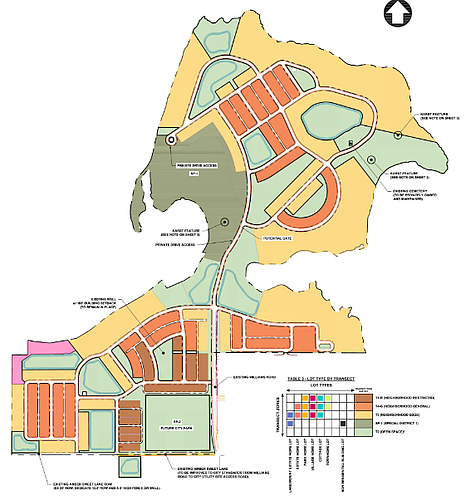
The Johns Lake Urban Village Planned Unit Development is a community planned on about 337.25 acres in Winter Garden near the Lake-Orange county line.
The proposal consists of 613 single-family homes and townhomes and two special districts.
Special District 1 will consist of parks, a bed and breakfast that includes 40 rooms, event space, agricultural uses and accessory retail/service uses in support of the property’s primary use.
Special District 2 will be reserved for a future Winter Garden city park.
Of the more than 337 acres, 85.26 acres will be open space, 16.86 will be active recreation and 3.65 acres will be dedicated for the future city park.
In terms of phasing, the development will be phased with no more than 50 units per phase, and there will be multiple builders, including custom builders. Although there might be one or two national builders, the focus is on custom builders to create varied elevations to avoid a “cookie-cutter community,” city Planning Director Kelly Carson said.
With 613 homes proposed, Carson said that is 1.82 dwelling units per acre — less than half the allowable density.
The residential units will be mixed and varied, with several small townhome and cottage lots up to lakefront estate homes that would be a minimum of 90 feet wide.
Special District 1 will include a 40-room bed-and-breakfast, as well as at least six cottages nestled among the trees. It would include a restaurant that would be available by reservation only, as well as some event space and buildings.
The current proposal will create 5,411 daily trips, with 408 total trips in the peak hour in the morning and 538 trips in the peak hour at night.
Numerous residents expressed concerns about the roads in the surrounding area already failing to provide enough capacity for traffic, but Carson said the developer only is responsible for addressing the impact on traffic caused by the development, not the existing traffic.
Carson said the developer is required to do several off-site improvements, including a roundabout at the intersection of Marsh and Williams roads. The developer also is required to develop Williams Road to city standards and connect the segment of Williams Road that goes to the Waterside community.
The developer also will be required to pay for 31.2% of the cost to construct a new northbound turn lane at the intersection of Marsh Road and Stoneybrook West Parkway.
Another requirement will be developing Amber Sweet Lane to the city standard. In addition, the developer will have to pay 21% of the cost and dedicate a 12-and-one-half feet of right-of-way to develop Amber Sweet Lane to the Lake County line.
Carson said the city will not widen Marsh Road because of site limitations and when a road is widened, it creates more traffic on the roads.
“The only way we could get enough right-of-way is basically to extend into some of the subdivision walls and create roads literally in people’s backyards,” she said. “In addition, we don’t want to create induced demand. Once you build a wide road with a lot of lanes, it attracts a lot of people to that road because they see it as an easy way to get from point A to point B, and then over time, that road fills up.”
Regional projects currently under construction and planned in the future will assist with traffic flow in the area, such as the 2027 completion of the New Independence Parkway, which will connect Wellness Way to Avalon Road and ultimately State Road 429.
City Attorney Kurt Ardaman said the city is in discussions with Central Florida Expressway Authority to look into potential opportunities to alleviate traffic coming from Lake County, such as installing a toll.
“I’m concerned for the traffic, but it’s an existing issue too, and we’re bound by not putting that on new development,” Commissioner Lisa Bennett said. “I love the tree study. It’s very important to me that we protect the trees and the waterways. I like that the developer has a vested interest and lives in the community. I feel too, if we ended up with another more dense (proposal), we wouldn’t get a 13-acre park donated. That would all be developed and there would be more traffic impact. Personal property owners do have rights as well. It’s a hard balance.”
A condition Sharman requested was that the developer will not receive any certificates of occupation for any of the units until New Independence Parkway is open and operational or Jan. 1, 2028, whichever comes first.
Only 50 units can be developed per phase of the project.
Another condition of approval is the developer will install a sound wall consisting of 10 feet of dense landscaping at the corner of Waterside on Johns Lake Tract B to address noise concerns.
Carson also addressed concerns regarding the writing of the ordinance. She assured city staff wrote the draft ordinance in April and sent the developer the draft, and the developer suggested several changes, “mostly to clarify and memorialize the transportation responsibilities.” She said staff accepted some of the developer’s suggestions and removed others.
During public comments, people expressed their concerns with the project and urged the commission to deny it while others were pleased to see the community proposal.
Many disapproving of the development had hoped the commission would delay approval of the project and focus on the existing traffic concerns on Marsh Road and Avalon Road.
“We don’t want to limit development, but we want to understand, can the infrastructure support these residents, and when is it going to be built because we’re already at a failing level currently,” Winter Garden resident Sarah Matin said.
Resident John Colombier said according to the traffic studies conducted for the development, even if the development was not constructed, the roads still will be over capacity by 2035, therefore it doesn’t make sense to approve the development.
Even with the regional traffic improvements planned, residents said those improvements address traffic from east to west, but there aren’t any plans to address traffic north to south, resulting in more traffic on Williams Road leading into areas that are more rural.
Orlando resident Kelly Miller said she doesn’t see how “it’s fair to pin the improvements in the traffic concerns to one particular development.”
“He’s done a great job with this development,” she said of Boyd. “We should take these concerns under consideration and make it a priority across the different municipalities.”
Dave Stewart, who lives in Clermont on Johns Lake, said although the traffic concerns are important, he is in full support of the project.
“I don’t want to see someone else, another family, not be able to enjoy what I enjoy just because I already have it,” he said.
Winter Garden’s Rick Steubing, president of the Johns Lake Association, said part of the association’s mission is to protect the water quality and the communities on the lake. The association’s board reviewed the plan and believes it is good for the lake and the communities. He said Boyd could sell the property, which could result in a national developer constructing homes at a maximum density, especially around the lake, which could cause more runoff to the lake and more boat traffic.
A couple residents questioned whether Bennett, a real estate broker, should recuse herself from the vote because they had concerns she would financially benefit from the development being approved.
Bennett repeatedly stated she had no financial interest in the development.