- June 30, 2026

-
-
Loading
Loading
A World War II-era political cartoon from the Chicago Daily Tribune depicting the Battle of Midway in 1942.
Sand and a piece of a parachute from an American parachuter on D-Day in Normandy, France.
A photo of the Tuskegee Airmen.
One of the first transatlantic radios made for the common man with a bomber as part of the design.
A phone set to have General George S. Patton yell at you once you answer.
A piece of the Berlin Wall.
A Japanese rifle, American rifle and Soviet rifle.
You would think you could find all these artifacts in history museums across the country as part of exhibits for World War I, World War II, the Cold War and more.
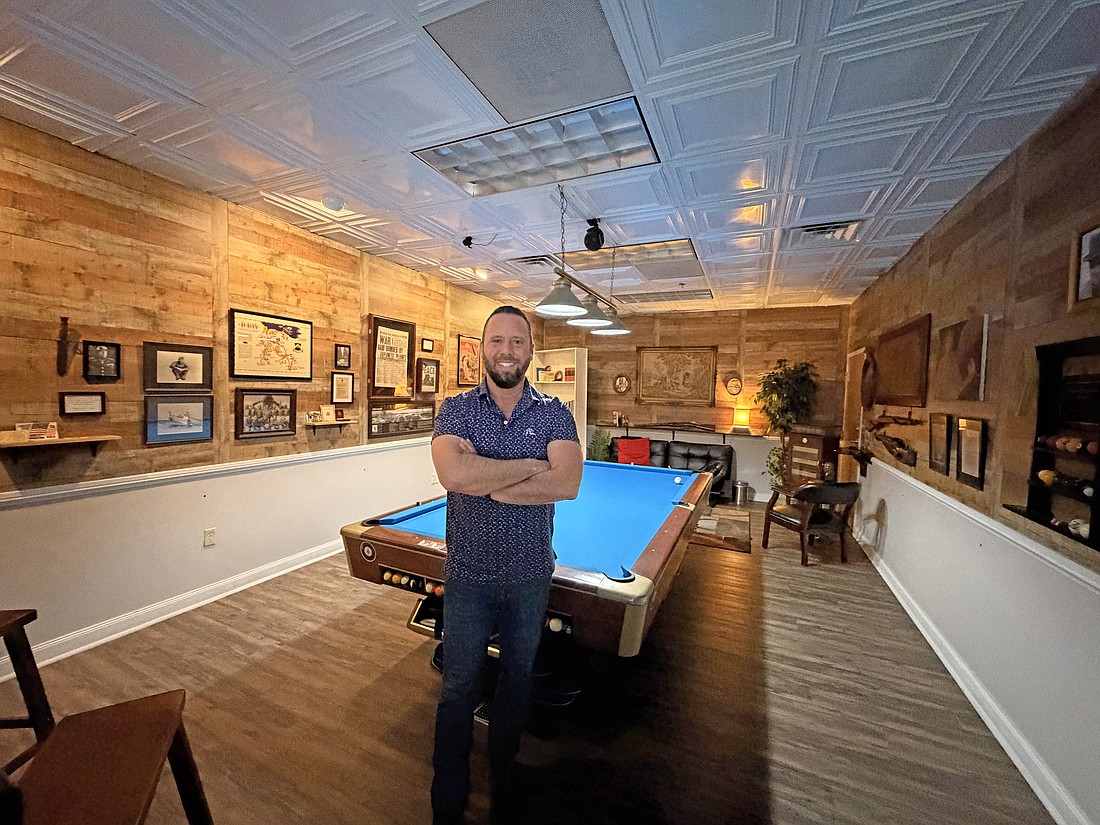
Instead, these artifacts — and many more — can be found in the secret room, known as the Churchill Room, behind a bookshelf in Austin Arthur and Zander Arthur’s office at Stripes and Stars Marketing Services in Winter Garden.
When COVID-19 forced the Arthurs to send their employees home to work remotely, the room, once filled with cubicles and employees, suddenly sat empty. The brothers transformed it into a billiards room filled with historical artifacts they have collected and been gifted throughout the years.
The Churchill Room, named in honor of Winston Churchill, has become a museum of sorts of not only world history, focusing mostly on World War II, but also on the Arthur family’s history.
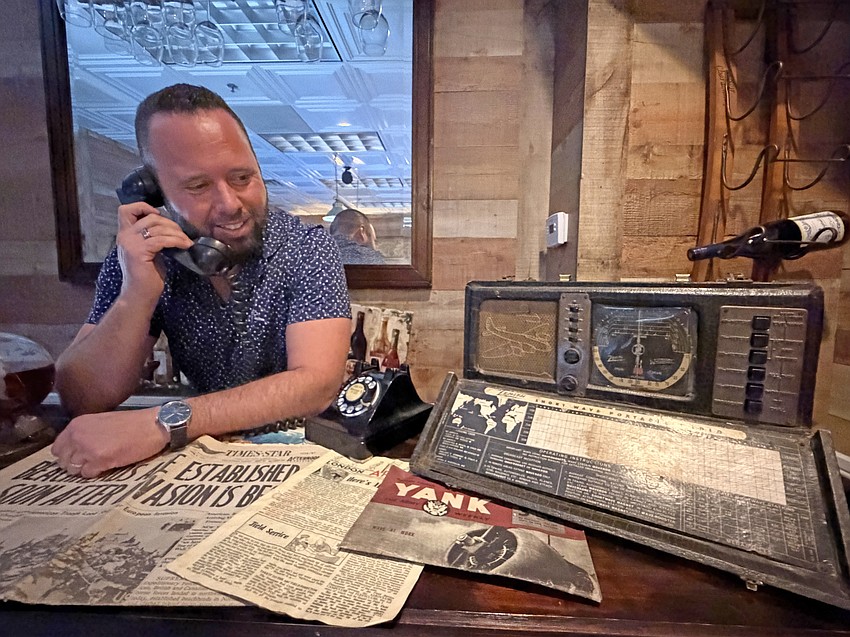
Growing up, Austin Arthur said his father only had either the news or documentaries on the History Channel playing on the TV.
It was through watching the news and History Channel daily that Austin Arthur discovered his passion for history. He learned at a young age that in order to not only not repeat the horrors of the past but also repeat the moral advances, a person must learn about history.
When the Arthurs had the empty space in their office, it was kismet that the favorite pool table from the late 1960s Zander Arthur played on growing up in Miami was available due to the pool hall closing.
Zander Arthur brought it to Winter Garden, and it started the collection of pieces in the room that hold significant meaning to the family. The collection expanded from there.
Austin Arthur said not everyone has pieces passed down generations, which he considers a travesty, so knowing they were blessed with heirlooms and pieces with historical significance, they felt the need to honor it.
The Churchill Room was born.
“When you close that bookshelf door and maybe you put on some very light 1940s jazz music, you go into a different time in the universe, and it becomes very reflective,” Arthur said. “You start to think about the things that are in the room. … You start to think about the lives that touched these objects or that influence of the images we’re seeing. What were they thinking about during that time? What were they doing during that time? And the amount of sacrifice and suffering through the time periods that are represented here.”
Arthur said if reminders like the ones in the Churchill Room don’t exist, society is bound to forget them.
“There’s something morally corrupt about not honoring your past,” he said.
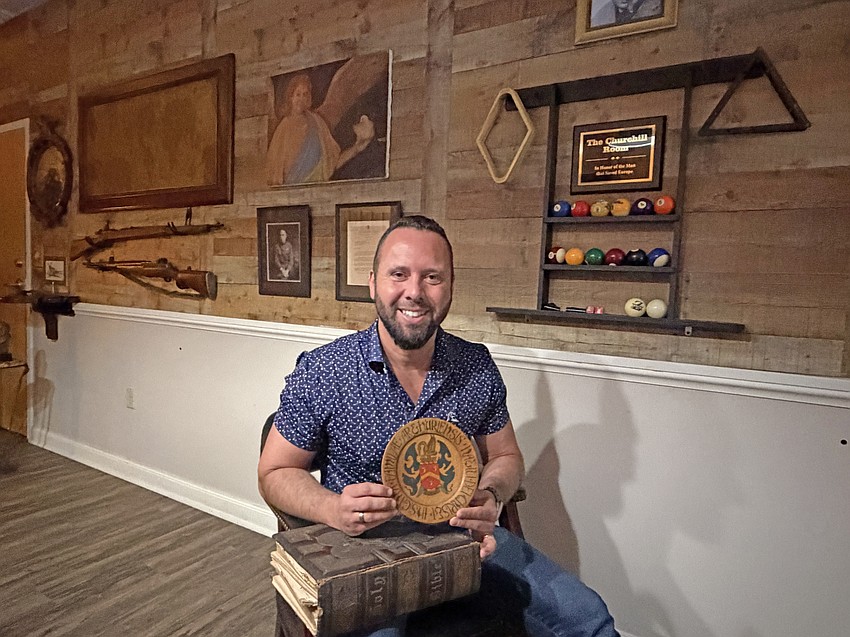
Throughout the four walls of the Churchill Room are dozens of pieces from moments in history.
A piece in the museum Austin Arthur treasures is a plate his grandfather, who served in World War II, made and painted with the family crest that goes back 300 years. The plate features a pious pelican mother bleeding on her chest because she’s sacrificing her body to feed her three starving children.
“She’s sacrificing her own life for her children, and of course, it’s a representation of Christ and how Christ spilled his flesh for us as children, so that we may live,” Austin Arthur said.
Photos of his grandfather and great-grandfather hang on the walls as well as the first painting his father created, which was an angel.
A knife also hangs on the wall.
Austin Arthur’s grandfather told him the story of how he retrieved the knife during World War II.
His grandfather said he was in the jungle and saw a Japanese soldier in the tree, so he shot him out of the tree and took his knife.
“We’re thinking, ‘Oh my gosh, Grandpa killed this Japanese soldier,’” Austin Arthur said. “I’m like, after the war, was that like a war crime or something? So we’re freaking out.”
When his grandfather died when Austin Arthur was in his early 20s, everyone gathered at his grandfather’s home after the funeral. He took the knife down, opened it and saw that it said “U.S.” engraved on it.
As Austin Arthur’s grandmother watched him and the other grandsons, she laughed. She couldn’t believe they thought their grandfather’s story was true.
The truth: The knife was part of his grandfather’s issued bayonet.
Another family heirloom is a Bible that sat on a pedestal in his grandmother’s home.
“I thought it was the first Bible ever,” Austin Arthur said. “I thought God, with a big feather, wrote it himself and sent it down to my grandma’s family in a lightning bolt.”
He never told his grandmother of his love for the family Bible, but when she died, he learned she had left the Bible to him in her will. Although the Bible’s spine barely holds the pages together, inside holds treasures of the Arthur family, which has owned it since the 1880s.
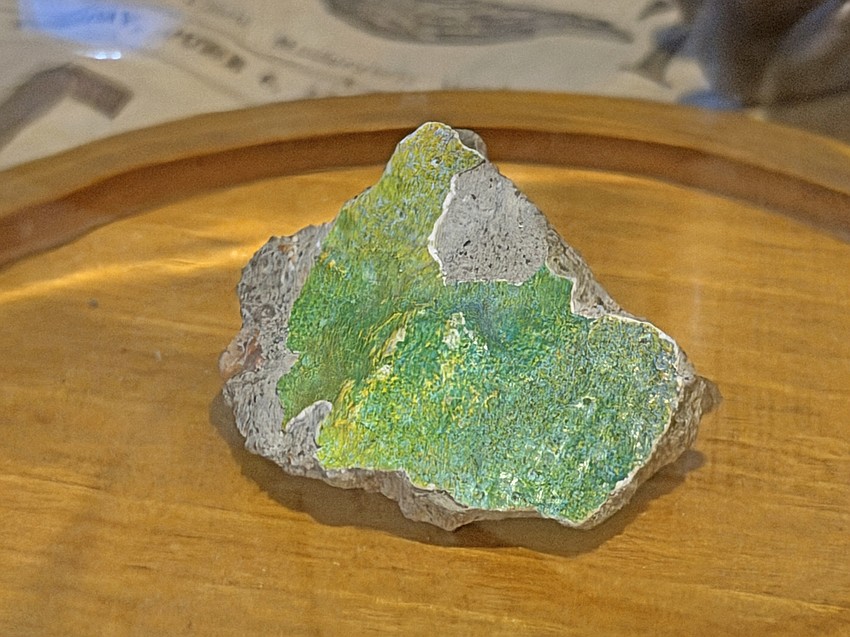
In terms of world history, one of Austin Arthur’s most treasured possessions is a rock.
What might seem like any other ordinary rock actually carries great significance. The rock has green paint on it because it was a part of the most narrow section of the Berlin Wall. The section only was 12 inches thick.
On the western side of the wall, people were allowed to graffiti the wall as part of political activism, allowing freedom of speech. The other side was a different tale. If someone laid a hand on the wall, that person was killed, Austin Arthur said.
“It’s estimated (more than) 100 men were killed trying to reach over to the west side to reach their family, to reach freedom,” he said. “It just shows you it’s such a symbol of how fragile freedom really is, 12 inches of concrete can be the difference between protesting the government and being killed just for touching a wall.”
Near the piece of the Berlin Wall in the Churchill Room is what Arthur calls the “area of good vs. evil,” showcasing his grandmother’s antique scale with the peace rose symbolizing good outweighing the Nazi Reichsmark from Nazi Germany and a Nazi postal stamp.
French horticulturalist Francis Meilland engineered the peace rose, which initially was named after his mother. But when the Nazis invaded Poland, he was worried his life’s work would be lost to history. He took cuttings of his rose and sent it to other horticulturalists throughout the world, including to a group in San Francisco that received it from the last flight out of France that came to America before the Nazi invasion, Arthur said.
When the United Nations met in 1945 for the first time after the war, they met in San Francisco, and everyone received a rose, which then was renamed the peace rose to honor the peace that was created by the fall of the Nazis and the end of the war.
Outside the Churchill Room, Austin Arthur’s love for history spills into the office he shares with his brother. That room has more of an American Revolution theme, featuring George Washington, the man Austin Arthur considers the greatest man who walked on Earth that is not a deity. He has Washington’s battle flag and a replica of Washington’s inaugural sword and morel.
Austin Arthur said he wants to grow his American Revolution collection because, in his opinion, it was “the most important conflict in world history.”
“It’s the spark that changed the world,” he said.